Almost every memecoin you have ever bought started life on a bonding curve. You may not have known it had a name, but you saw its effects: a progress bar creeping toward 100%, a price that climbed with every buy and fell with every sell, and a promise that something would happen when the bar filled up.
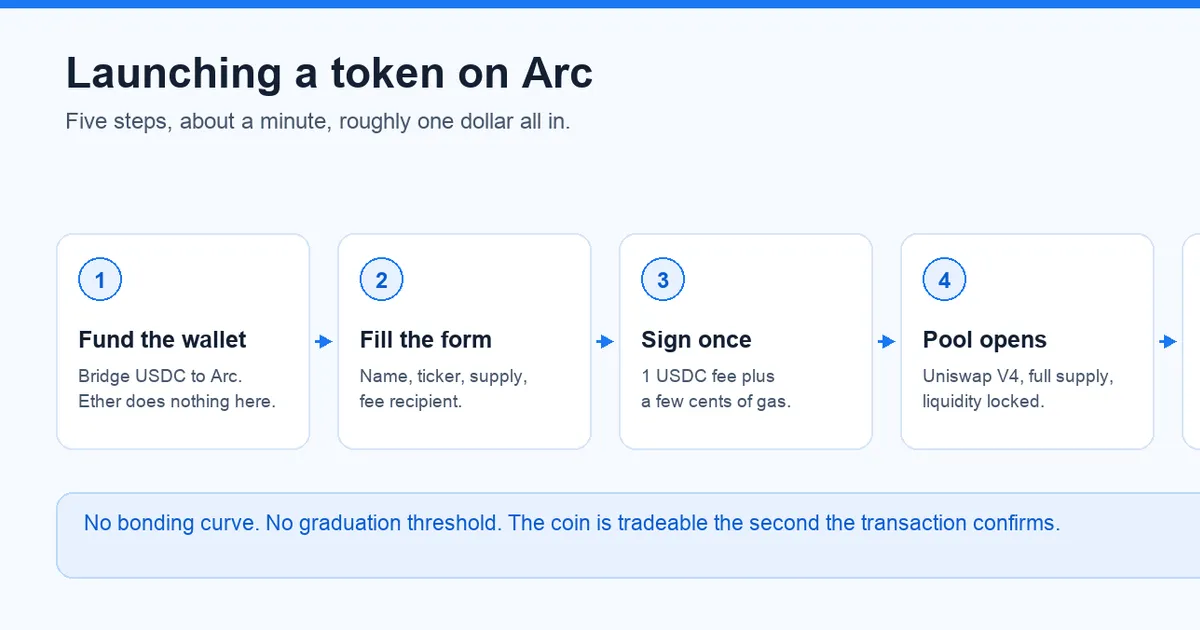
The alternative is older and simpler. The coin opens as an ordinary liquidity pool on a decentralised exchange, the same kind of pool that holds ETH and USDC, and it trades that way from its first block. No progress bar, no migration, nothing to wait for.
Both models are defensible, and the marketing around each is mostly noise. What follows is what actually differs between them, what the numbers say about how often the curve model delivers on its promise, and how to pick the one that suits what you are launching.
What a bonding curve actually is
A bonding curve is a formula that sets a token's price from how much of its supply has been sold. Not from supply and demand in the usual sense, and not from what anyone else is willing to pay. From a single input, running through a fixed equation, with a completely predictable output.
Buy from the curve and it mints tokens to you and moves the price up. Sell back and it burns them and moves the price down. There is no counterparty on the other side of your trade. You are trading against arithmetic.
That is the part people find strange at first. On a normal exchange, your buy needs someone else's sell. A bonding curve removes that requirement entirely, which is exactly why launchpads love it.
The formula in plain words
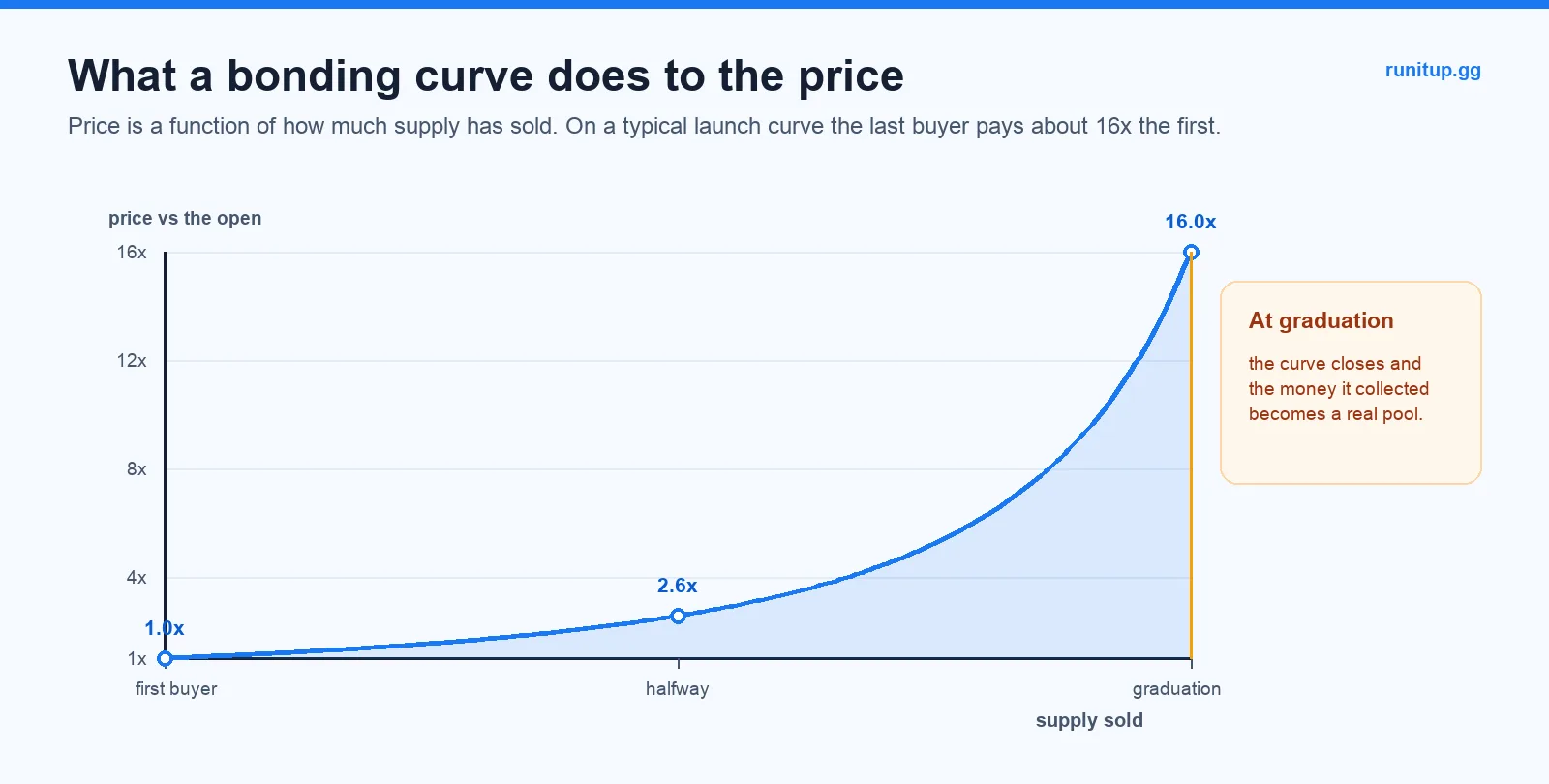
Most launch curves are some flavour of "price rises faster as supply sells out". Early buyers get a low price, later buyers pay more, and the gap between the first and last buyer can be very large.
The curve also starts with what are called virtual reserves. It quotes a price before anybody has put in a single dollar, because the formula does not need real money to produce a number. That is how a coin can have a market cap thirty seconds after it is created, with nothing actually backing it.
What that looks like in numbers
Take a supply of one billion with 800 million offered on the curve, which is roughly the standard shape. The price you pay depends entirely on how much has already been sold before you arrive.
| Supply sold | Roughly where you are | What you are paying |
|---|---|---|
| First 10% | The opening minutes | The cheapest price the coin will ever have |
| 50% | The progress bar is halfway | Several times the opening price |
| 90% | Graduation is close | The most expensive tier on the curve |
The exact multiples differ per platform, but the shape does not. The gap between the first buyer and the last one is the entire point of the design, and it is why the opening seconds of a bonding curve launch are so heavily contested by bots.
What a liquidity pool actually is
A liquidity pool holds two assets and lets people swap between them. To open an ETH and COIN market, somebody deposits both, and the pool prices trades off the ratio between them.
Nothing is minted or burned when you trade. The tokens already exist, and a swap just moves them between you and the pool. The price moves because the ratio inside the pool moves.
How an automated market maker prices a token
The machinery that does this is called an automated market maker. The classic version keeps the product of the two balances constant, so taking tokens out makes the remaining ones more expensive, in a way that never quite runs out of either side.
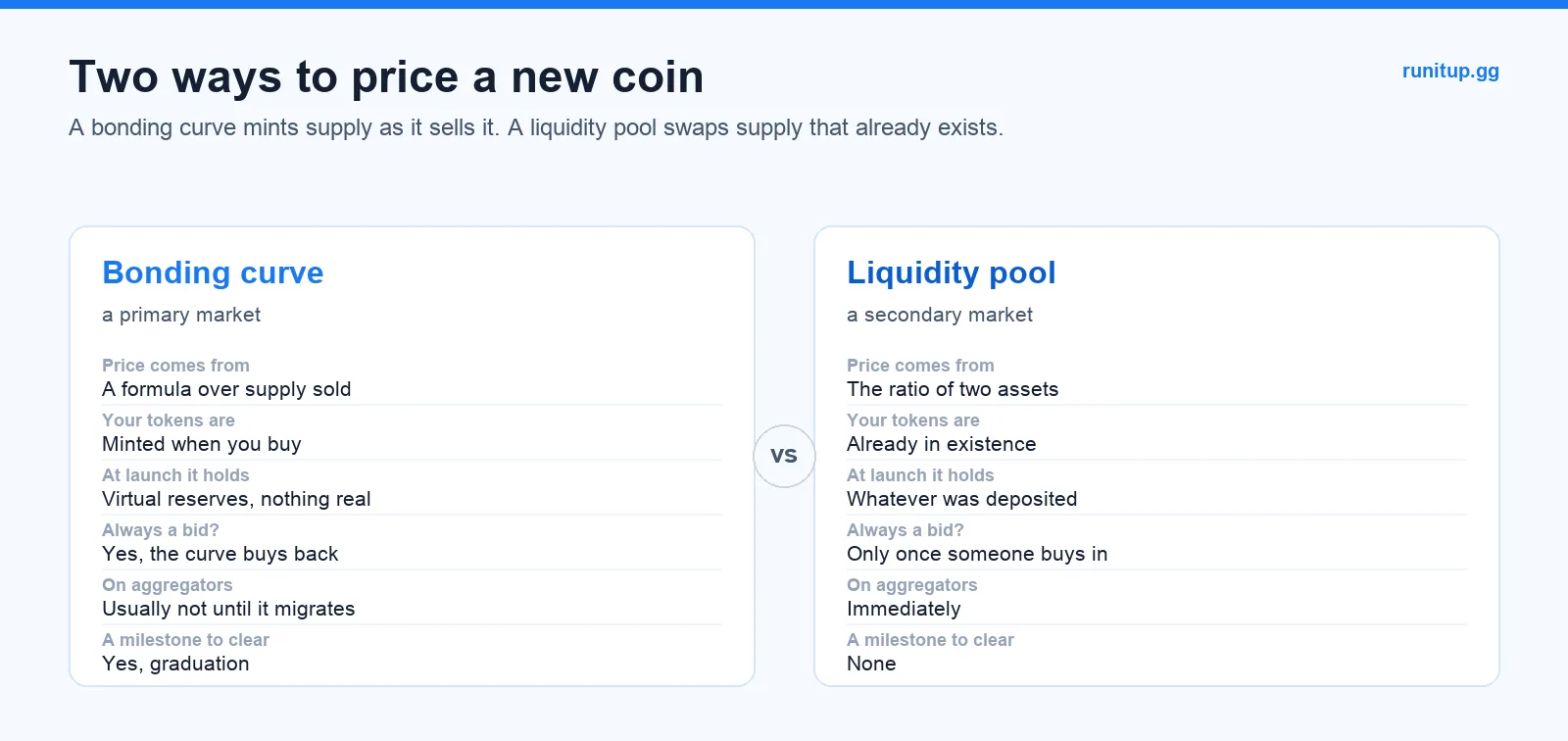
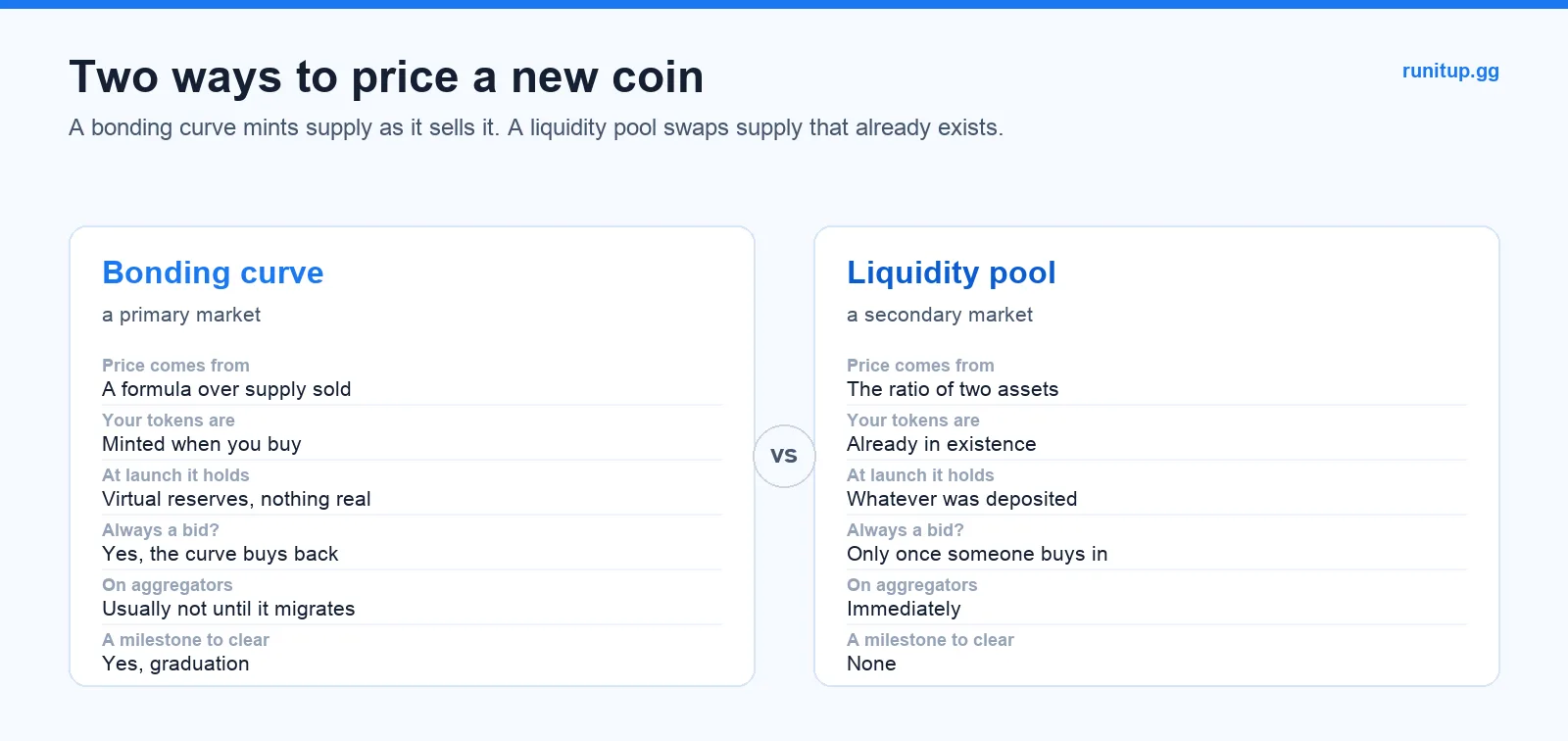
The practical consequence is that an automated market maker is a secondary market. It prices things that already exist and are already owned. A bonding curve is a primary market, creating supply as it sells it. That single distinction explains almost every other difference below.
Bonding curve vs liquidity pool: the differences that matter
Here is the comparison stripped of marketing on both sides.
| Bonding curve | Liquidity pool | |
|---|---|---|
| Price comes from | A formula over supply sold | The ratio of two assets |
| Tokens are | Minted and burned as you trade | Already in existence |
| At launch it holds | Nothing real, just virtual reserves | Whatever was deposited |
| There is always a bid | Yes, the curve always buys back | Only if someone supplied the quote asset |
| Visible on DEX aggregators | Usually not until it migrates | Immediately |
| Composable with other DeFi | Rarely, until it migrates | From the first block |
| A milestone to reach | Yes, graduation | No |
| Can fail to become a real market | Yes, and usually does | No |
Read the last two rows together, because that is the whole argument. A bonding curve introduces a threshold the coin has to clear before it becomes a normal tradeable asset. A pool has no threshold, because it is already the thing the curve is trying to become.
What token graduation actually is
Token graduation is the moment the curve closes and the accumulated money becomes a real pool. It is automatic, it is irreversible, and on the best-known launchpad it happens at roughly $69,000 of market cap, which is about 85 SOL of cumulative buying.
The mechanics are neat, and the best-known launchpad documents its own curve publicly. Of a one billion supply, around 800 million sell through the curve. The remaining 200 million get paired with the accumulated SOL and deposited as a liquidity position on an exchange. The coin that comes out the other side is an ordinary pool-traded token.
So graduation is not a promotion or an endorsement. It is a plumbing event: the curve converting itself into the liquidity pool it was always going to become.
It happens in one transaction, and it runs like this:
- The curve hits its threshold and stops accepting trades.
- The accumulated quote asset, the SOL or ETH people spent, is withdrawn from the curve.
- The reserved slice of supply is paired against it.
- That pair is deposited into a real pool on an exchange.
- The resulting position is usually burned or locked, and trading resumes against the pool.
From step five onward, the coin behaves exactly like one that launched as a pool in the first place. The bonding curve has done its job and no longer exists in the path of a trade.
The number almost nobody quotes
Here is the part the progress bar does not tell you.
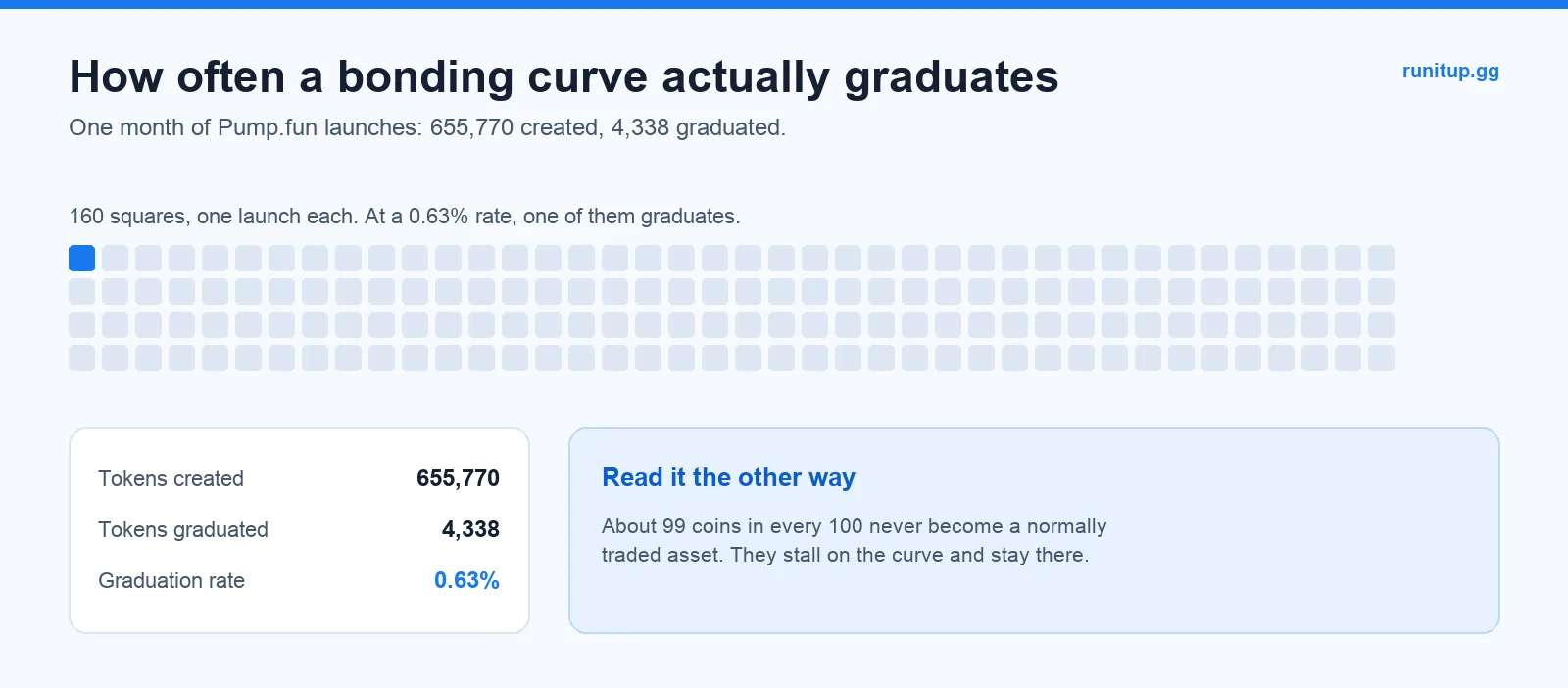
An academic study of Pump.fun tracked 655,770 tokens created in a single month and found that 4,338 of them graduated. That is 0.63%. Over the platform's whole life, from launch through August 2026, the commonly cited figure is still under two percent.
| Tokens created in the sample month | 655,770 |
|---|---|
| Tokens that graduated | 4,338 |
| Graduation rate | 0.63% |
Turn it around and it reads more honestly. Around 99 in every 100 coins launched on a bonding curve never become a normally traded asset at all. They stall somewhere on the curve, attract no further interest, and sit there at a price nobody is testing.
That is not an argument that bonding curves are a scam. It is an argument that the graduation milestone is rare enough that you should not plan around reaching it.
Why launchpads use a bonding curve at all
Given that failure rate, the popularity of the bonding curve needs explaining. There are four real reasons, and they are good ones.
It solves the cold-start problem. A new pool needs someone to deposit both sides. A bonding curve needs nobody to deposit anything, because it quotes prices from virtual reserves. The creator puts up no capital.
There is always a bid. This one matters more than people realise. As the curve takes in money, it holds that money, so it can always buy your tokens back. You can sell at any time, even when not a single other human wants to buy.
It accumulates the liquidity automatically. Every buy adds to the pot that eventually becomes the pool. The curve is a fundraising mechanism wearing a trading interface.
Graduation is free marketing. A progress bar is a countdown, and countdowns create urgency. The milestone gives traders something to coordinate around.
Where the bonding curve model costs you
The same design has costs, and they are rarely stated plainly.
- Your coin is not really listed yet. Until it migrates, it usually will not appear on the aggregators where traders actually browse, so discovery depends on the launchpad's own interface.
- It is not composable. Other protocols cannot easily build on a curve. No lending market will take it as collateral, and no router will path a trade through it.
- The odds are against the milestone. See the 0.63% above. Designing your plan around graduation means designing around the rare case.
- Trading is against a formula, not a market. The price on the curve tells you how much has been bought, not what anyone thinks the thing is worth.
- There is a migration to get through. Any extra step is an extra place for things to go wrong, and the mechanics differ between platforms.
Where a direct pool costs you
An honest comparison has to run the other way too, and most articles written by launchpads skip this part.
Somebody has to set the opening price. A curve discovers its starting price by beginning near zero. A pool cannot do that, so the platform picks an opening valuation for you. On a launch quoted in USDC on Arc that number is fixed at $2,700 for everyone, which is fair but not chosen by you.
There may be no bid at the start. This is the real structural trade-off. A single-sided pool opens holding only your token and none of the quote asset. Nobody can sell into it until somebody has bought, because there is nothing on the other side to pay them with. A bonding curve, holding its accumulated reserve, always has money to hand back.
There is no built-in moment. No progress bar, no countdown, no graduation to rally around. If you want attention, you have to create the reason for it yourself.
Early buyers still get the best price. A pool opened at the bottom of its range rewards whoever transacts first, exactly as a curve does. Neither model solves sniping.
Which model suits which launch
Strip away the ideology and the bonding curve question comes down to what you actually have.
| If this is true | Lean toward |
|---|---|
| You have no audience yet and want price discovery from near zero | A bonding curve |
| You want traders to find the coin on aggregators immediately | A liquidity pool |
| You want a guaranteed bid under the price from minute one | A bonding curve |
| You want the coin usable by other protocols straight away | A liquidity pool |
| You want a milestone to build a campaign around | A bonding curve |
| You think planning around a 1-in-160 event is a bad plan | A liquidity pool |
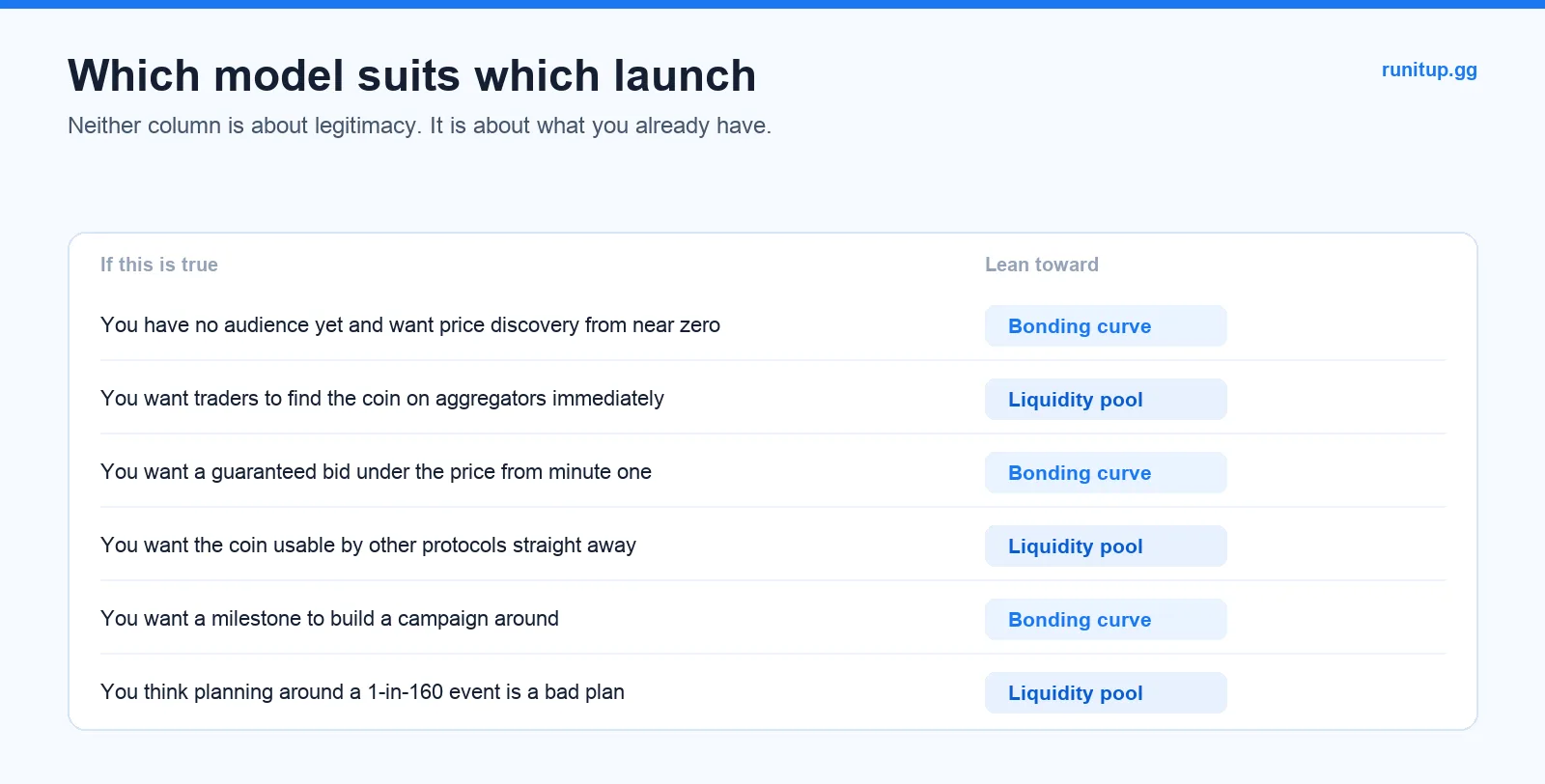
Notice that neither column is about which is more legitimate. A bonding curve is a perfectly reasonable way to bootstrap something from nothing, and it is genuinely better than a pool when you have no audience and no capital.
The honest case against it is narrower than its critics claim. It is simply that the model's headline benefit, graduation into a real market, almost never arrives, and a pool hands you that outcome at the start instead of dangling it at the end.
Mistakes people make with both models
A few patterns come up repeatedly, whichever route you take.
- Reading market cap on a curve as real. A curve quotes a price from a formula and virtual reserves. A six-figure market cap can sit on top of a few thousand dollars of actual buying.
- Treating the progress bar as momentum. It only ever moves one way in the aggregate, and it says nothing about whether anyone will still be there tomorrow.
- Assuming graduation means safety. It means the plumbing changed. It is not a review of anything.
- Assuming a pool means locked liquidity. Those are separate properties. A pool can have its liquidity pulled unless the position is locked, so check the lock rather than assuming it.
- Comparing fees without checking who collects during each phase. On many curve platforms the trading fees during the curve phase go somewhere different from where they go afterwards.
Common questions
Can a bonding curve token be rugged?
The curve itself cannot have its liquidity pulled, because there is no LP position for anyone to withdraw while the coin is still on it. The risk moves to what happens after migration, and to whoever holds a large share of the supply. A bonding curve constrains one failure mode and does nothing about the others.
What happens if a bonding curve never fills?
Nothing, which is the problem. The coin keeps trading against the formula at whatever level it stalled at. It does not expire, it does not refund anyone, and it does not migrate. Given that this is the outcome for roughly 99 launches in 100, it is the default case rather than the edge case.
Is a bonding curve the same as a presale or an ICO?
No. A presale sets one price for everyone and usually locks your money until a date. A bonding curve prices every buyer differently by position, and lets you sell back at any moment. The fixed formula is doing a similar fundraising job, but the mechanics and your exit rights are quite different.
Do fees work differently on a bonding curve?
Usually yes, and this catches people out. Many platforms take a fee on every curve trade that goes entirely to the platform, then switch to a pool fee after migration that may be shared with the creator. Check both numbers before launching, because the phase your coin spends most of its life in is the curve.
Where to start
If you are choosing between these for a launch of your own, the useful question is not which mechanism is cleverer. It is whether you would rather start with a real market and have to bring the attention yourself, or start with a game and hope the attention carries you through it.
Most people, once they see the graduation numbers, decide they would rather have the market. That is a defensible read of a 0.63% success rate, though it is not the only one. If you genuinely have nothing and no one, the curve's ability to price a coin from zero with no capital is a real advantage that a pool cannot match.
Whichever you pick, verify the things that actually protect a buyer. Check whether liquidity is locked and who holds the position, check whether the contract is verified, and check where the trading fees go. Those questions matter more than the shape of the price function, and they are worth more than any progress bar.