Circle switched Arc mainnet on in September 2026, and within a day most of the trading volume on it was coming from token launchpads rather than the payment rails it was built for. If you want to launch a token on Arc while the chain is still young, the process is genuinely short. It is also unlike launching anywhere else, because Arc's gas token is USDC.
That one design decision changes almost everything downstream. Your launch fee is denominated in dollars, your gas bill is denominated in dollars, and the pool your coin opens into is quoted in dollars. There is no volatile gas asset to buy first, and no exchange rate to worry about between funding your wallet and confirming the transaction.
This guide covers what it costs to launch a token on Arc, the wallet setup you need, the five steps of the launch itself, and the two Arc-specific traps that catch people afterwards: contract verification and a scanner that will probably call your token a honeypot.
What Arc mainnet is, and why it matters for launches
Arc mainnet is a Layer 1 blockchain from Circle, the company behind USDC. It went live on 16 September 2026 after nearly a year of testnet. It is not a rollup and it does not settle to Ethereum. It runs its own consensus with roughly half-second blocks, and its founding validators are institutions like BlackRock, Visa, Mastercard and DTCC.
Two properties matter if you plan to launch a token on Arc. The first is deterministic finality: once your transaction is included, it is final, with no reorganisation window. Your pool cannot be un-created by a chain reorg a few blocks later.
The second is the gas token. On Arc mainnet, gas is paid in USDC. Not in ether, not in a chain-specific governance token, and not in a wrapped stablecoin. That makes every cost in this article a dollar figure rather than an estimate that moves with the market.
There is a third property worth knowing before you commit. Arc enforces some compliance rules at the protocol level, and transfers can revert on those grounds. For an ordinary memecoin this will not affect you, but it is a real difference from a permissionless chain like Base, and you should know it exists before you launch a token on Arc rather than after.
Should you launch a token on Arc at all?
Worth asking honestly before you spend anything. Arc is new, and new cuts both ways.
The case for choosing to launch a token on Arc is real. Costs are tiny and predictable, blocks are fast, finality is immediate, and the chain is quiet enough that a launch is not instantly buried under thousands of others. Circle's involvement also means the infrastructure is unlikely to simply vanish.
The case against is equally real. Liquidity on Arc is thin compared with established chains, the tooling around it is visibly catching up, and the audience of traders who have bridged funds there is small. A coin nobody can find is not helped by cheap gas.
Here is a plain comparison of what changes:
| Factor | Arc | An established launch chain |
|---|---|---|
| Gas asset | USDC, so costs are in dollars | A volatile token you must buy first |
| Cost per launch | About a dollar | Cents to tens of dollars, varying |
| Finality | Immediate, no reorgs | Usually probabilistic |
| Trader population | Small and early | Large and crowded |
| Scanner support | Incomplete for Uniswap V4 | Mature |
If your plan depends on walk-up traffic from people already browsing a busy chain, launching somewhere established makes more sense. If you are bringing your own audience, the quiet is an advantage rather than a cost.
Before you launch a token on Arc: wallet and network setup
To launch a token on Arc you need an EVM wallet that lets you add a custom network. MetaMask, Rabby and most browser wallets handle this. You do not need a Circle account, and you do not need to be an institution.
The Arc chain ID and RPC details you need
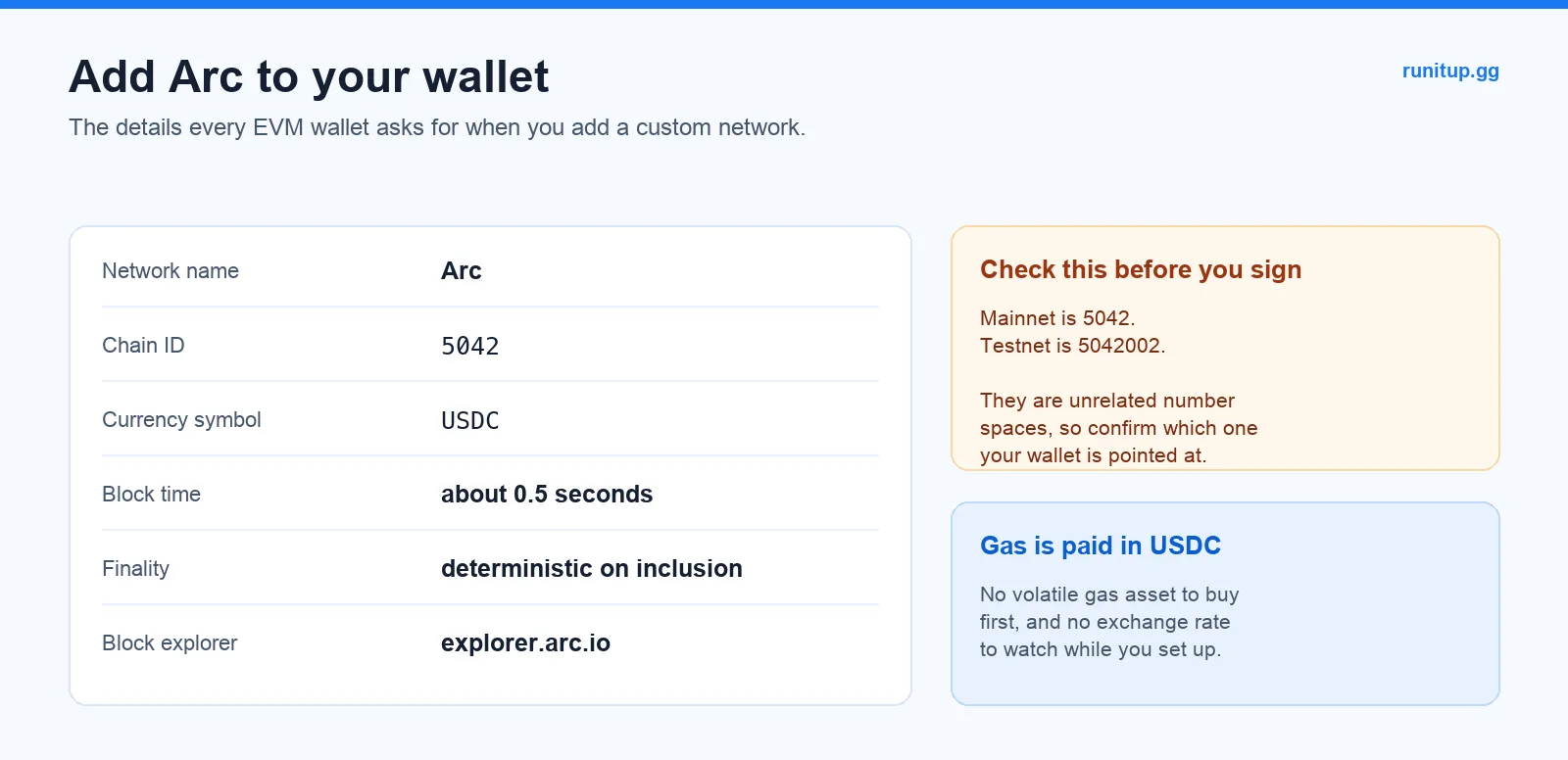
The Arc chain ID for mainnet is 5042. The testnet, which has been running since late 2025, is 5042002. These are unrelated number spaces, so confirm which one your wallet is actually pointed at before you sign anything. Launching on the testnet when you meant mainnet is a cheap mistake, but a confusing one.
| Setting | Arc mainnet |
|---|---|
| Chain ID | 5042 |
| Currency symbol | USDC |
| Block time | ~0.5 seconds |
| Finality | Deterministic on inclusion |
| Block explorer | explorer.arc.io |
Circle publishes current RPC endpoints in the official Arc documentation, and that is the source to trust rather than a list copied into a blog post that may be stale by the time you read it. Provider choice on Arc is still thin compared with an established chain, so if you are automating anything, plan for a fallback endpoint.
Why USDC gas changes the maths
On most chains the first thing you do before a launch is acquire the gas asset, watch its price, and hope it does not move while you are setting up. Arc removes that step. You fund the wallet with USDC, and that same balance pays for gas, pays the launch fee, and quotes your pool.
This is why USDC gas is more than a novelty. It makes the cost legible in advance. When someone says it costs about a dollar to launch a token on Arc, that is not a conversion at today's rate. It is a dollar.
The decimals trap that catches developers
If you are writing code against Arc rather than using an interface, one trap deserves a flag. USDC on Arc exists at two different decimal scales at once. As the native gas asset it uses 18 decimals, following the EVM convention. As an ERC-20 token, in balanceOf and in transfer logs, it uses the usual 6.
Those are the same underlying balance expressed a trillion apart. Any code that reads both paths and does arithmetic across them will be silently wrong by a factor of 10^12 until the number reaches a human. Carry the native and ERC-20 decimals as separate constants, never one shared value, and put a sanity check on any computed dollar figure.
Creators using a launch interface never touch this. It is here because it is the most common way an Arc integration breaks.
What it costs to launch a token on Arc
Here is the part most guides get wrong. Search for the cost of launching a token and you will find development agencies quoting five and six-figure budgets, because they are selling a bespoke contract and an audit. That is a different product answering a different question.
On a launchpad, the numbers to launch a token on Arc are these:
| Item | Cost on Arc |
|---|---|
| Launch fee | 1 USDC |
| Gas for the launch transaction | A few cents |
| Liquidity you must supply | None |
| Share of supply handed to the platform | None |
The gas figure is small because the launch opens a Uniswap V4 pool, costing roughly 1.35 million gas against about 6.2 million for the equivalent V3 launch. On a chain that bills gas in dollars, that efficiency reaches you as money rather than as a ratio.
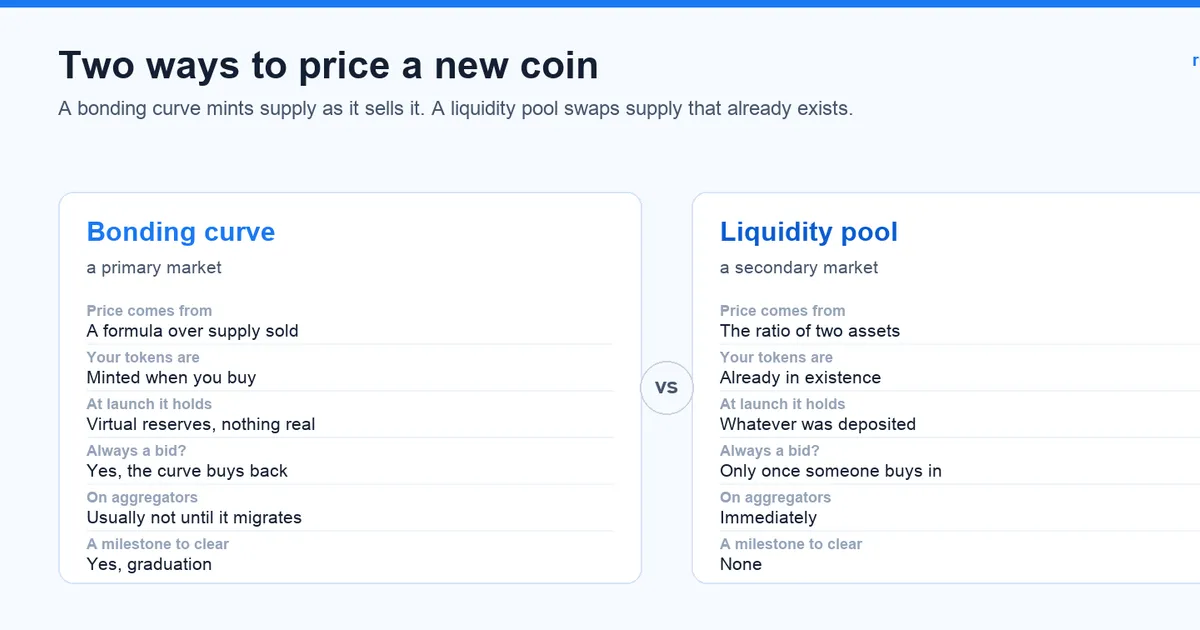
The "no liquidity required" line is the one people disbelieve, so it is worth explaining. A launch on RunItUp's single-sided pool deposits your entire token supply and no money at all, with the position's lower edge pinned at the opening price. A one-sided position works because below the starting price it holds no quote asset, and does not need to. That is what lets you launch a token on Arc without funding a pool yourself.
The five steps to launch a token on Arc
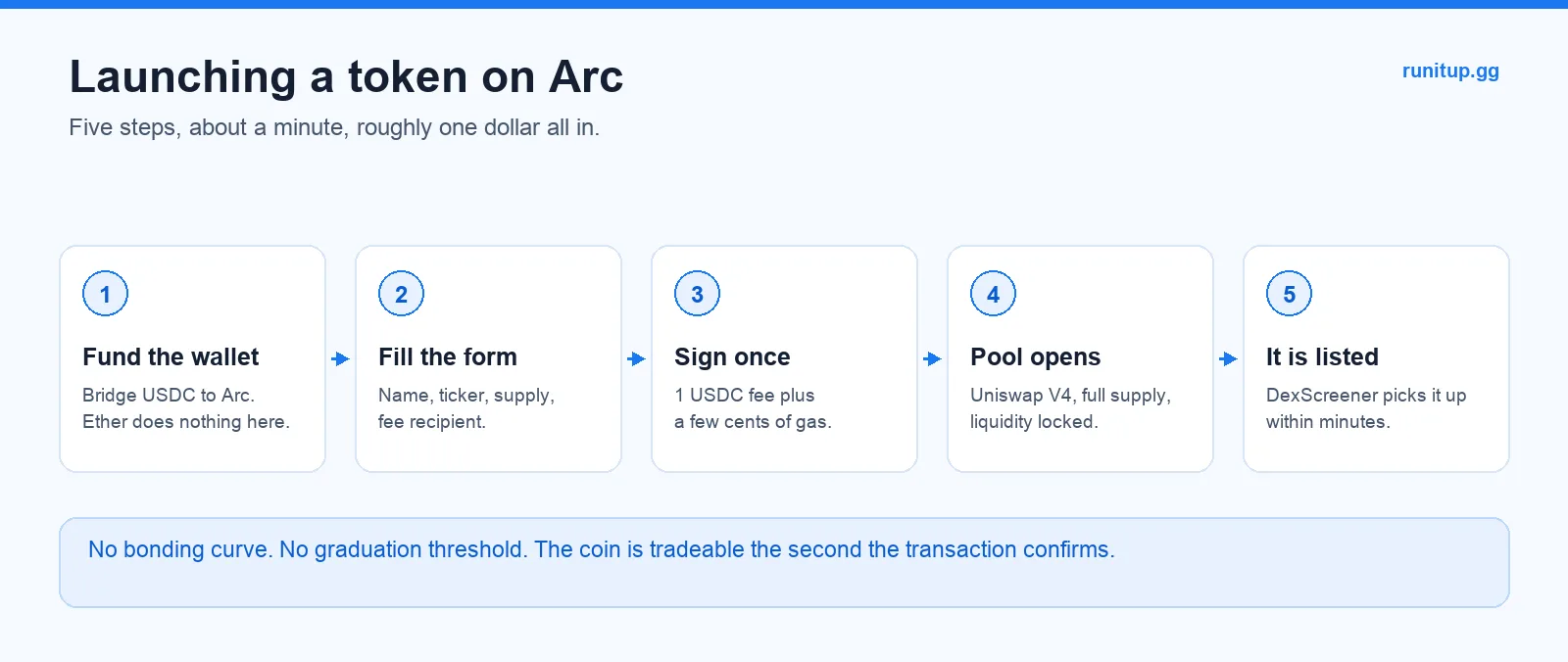
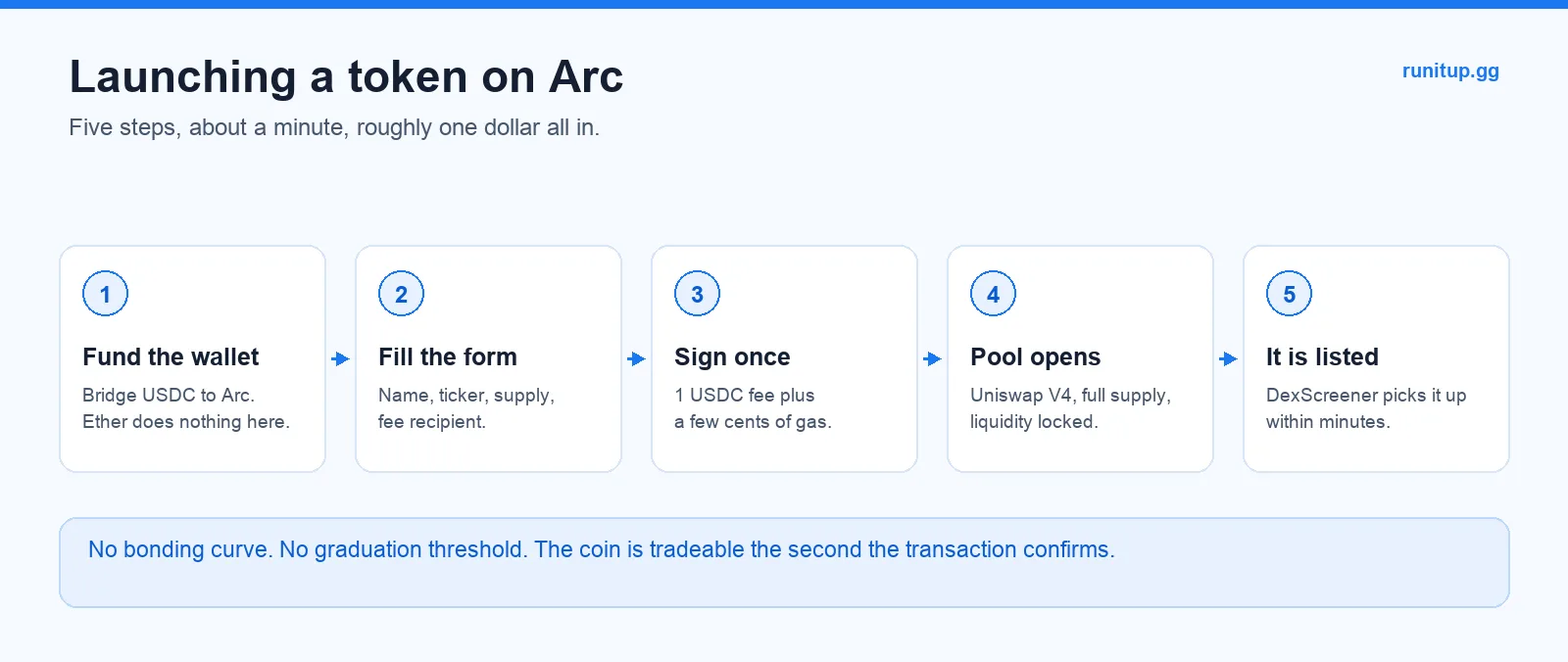
The whole flow to launch a token on Arc takes a couple of minutes once your wallet is connected. Open the launch page and pick Arc as the chain.
1. Fund the wallet with USDC
Bridge or transfer USDC to your Arc address. Circle's Cross-Chain Transfer Protocol is the native route, and several third-party bridges support Arc as well. You need enough to cover the 1 USDC fee and a few cents of gas, so a handful of dollars is plenty. Remember that your ether is useless here.
2. Pick your name, ticker and supply
Four fields are actually required: a name, a ticker, a total supply within the allowed range, and a valid fee recipient. Everything else on the form, including the image, description and social links, is optional and editable later. The name and ticker are permanent, so read them twice.
3. Set the fee recipient
This is pre-filled with your connected wallet, and it is the address that receives your share of every trade. You can change it later, and you can point it at a different wallet from the one launching. If a community ever takes the project over, this is the field that moves.
4. Confirm and watch the pool open
Sign the transaction. When you launch a token on Arc there is no bonding curve to fill and no graduation threshold to reach. Your coin opens directly as a real pool on Uniswap's official V4 deployment, holding its full supply, tradeable the second the transaction confirms.
5. Check the listing
DexScreener indexes Arc pools from Uniswap's official V4 PoolManager, and in practice a new pool shows up within minutes. Your pair identifier there is the V4 pool id.
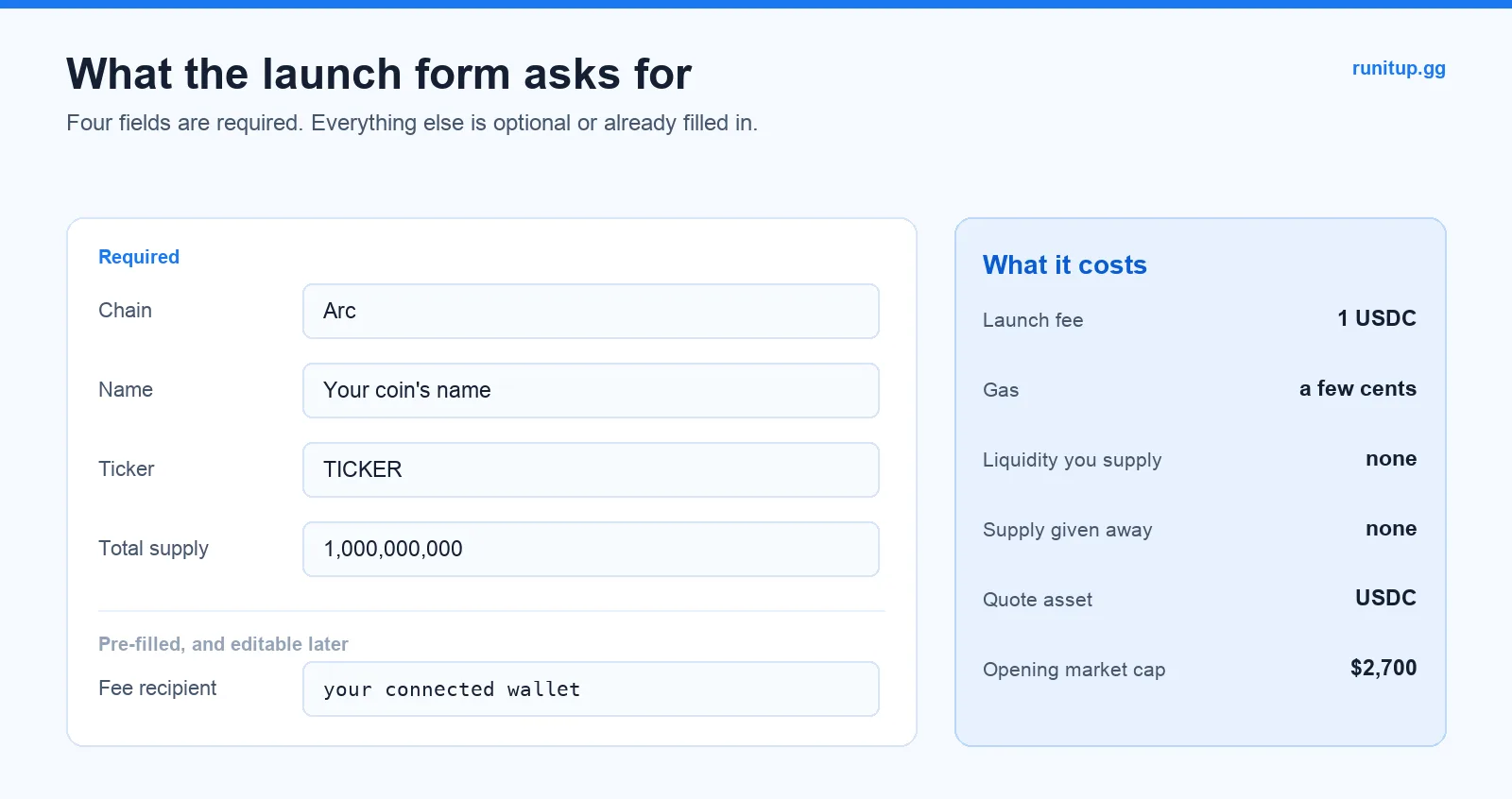
Two honest caveats apply when you launch a token on Arc today. Every launch opens quoted in USDC at a starting market cap of $2,700, and unlike on Robinhood Chain there is no menu of quote assets to pair against. Taxed launches are also currently paused on Arc, so the tax hook and dividend vault are unavailable there. If you need either, that is a reason to launch elsewhere for now.
How to verify a contract on Arc
This step surprises people, and it is worth doing properly because it affects how your token looks to everyone who inspects it.
To verify a contract on Arc, use Sourcify. It supports chain 5042 and it works. Arc's block explorers do not offer working source verification, for reasons that are specific and worth knowing:
- The Circle explorer sits behind an access login.
- Arcscan blocks scripted requests outright.
- The third explorer has an Etherscan-style API, but it rejects request bodies over roughly 200 KB and stores no runtime bytecode for contracts created by other contracts.
That last point is the killer. Every token from a launchpad is created by a factory contract, which means it can never be verified on that explorer no matter how correct your submission is. Worse, its status endpoint can report a pass for a junk submission while the source endpoint still says unverified, so the status is not trustworthy.
If you launch a token on Arc through a platform, the factory and token contracts should already be verified on Sourcify for you. Check rather than assume.
Why a scanner may call your Arc token a honeypot
Expect this one when you launch a token on Arc, because it will probably happen and it is not your fault.
Quick Intel, the scanner behind the safety box on DexScreener, simulates a sell through Uniswap V2 and V3 routers only. It does not support Uniswap V4 on any chain, and Arc is not in its chain list. The result is that it reports "Honeypot: Yes" and unknown taxes on effectively every V4 token on Arc, including ones trading normally with permanently locked liquidity.
A second auditor, Serialized Audit, reads the explorers rather than Sourcify, so it reports your contract as closed source even when the source is verified and public.
Neither result reflects anything about your token. If it comes up, point people at the actual sells landing on chain and at your Sourcify entry, and read the security documentation on what scanners can and cannot see. It is a tooling gap that will close as V4 support spreads, but right now it is part of the cost of new infrastructure.
Mistakes to avoid when you launch a token on Arc
Most problems people hit when they launch a token on Arc are avoidable, and happen before the transaction is signed.
- Funding with the wrong asset. Ether does nothing on Arc. Bridge USDC, not the gas token you are used to.
- Signing on the wrong network. Confirm the chain ID reads 5042 and not 5042002.
- Treating the ticker as editable. The image and description can change. The name and ticker cannot.
- Pointing fees at an address you do not control. The fee recipient defaults to your wallet for a reason. Change it deliberately or not at all.
- Panicking at a honeypot flag. Verify on Sourcify, show a real sell, and move on.
- Expecting a bonding curve. There is no curve and no graduation, so there is no pre-launch accumulation phase to plan around.
What you earn after you launch a token on Arc
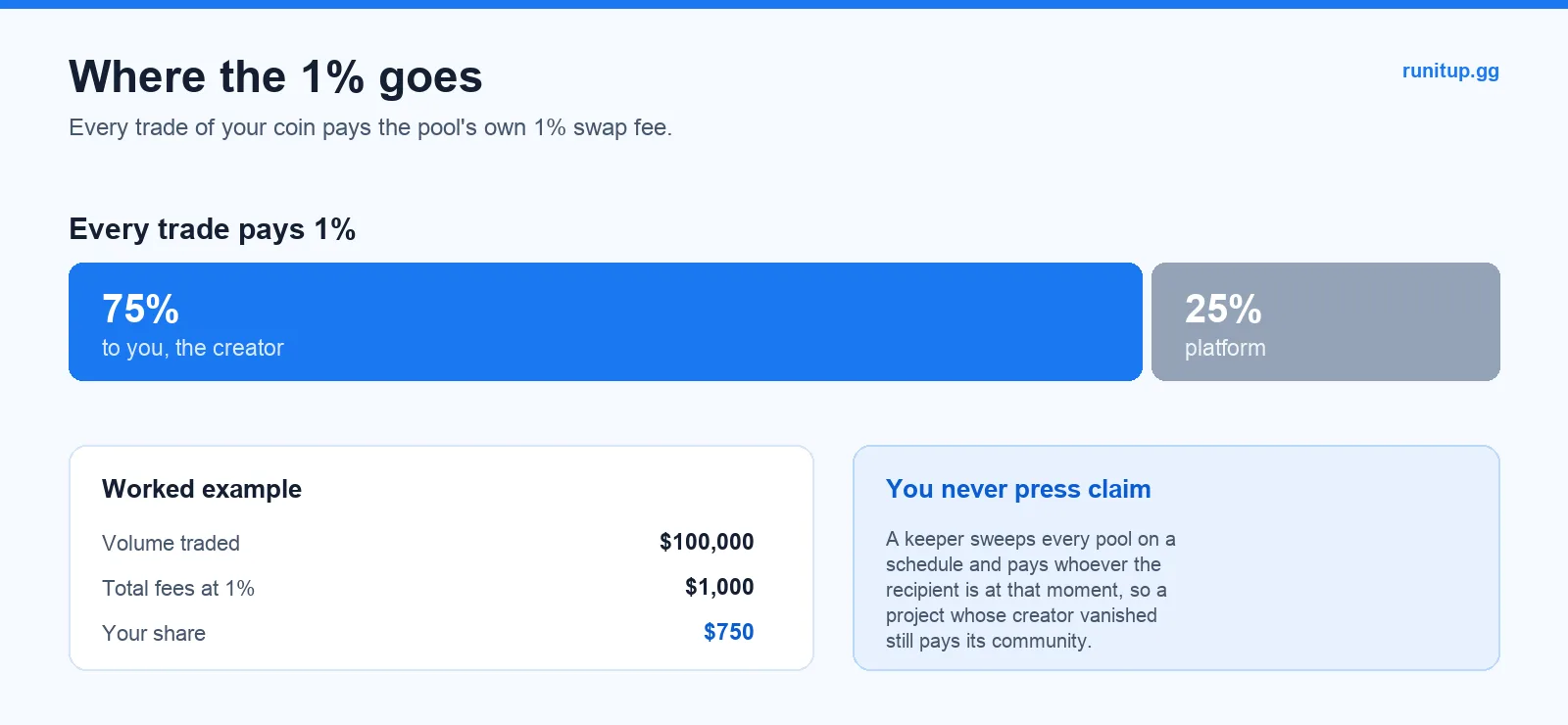
Once you launch a token on Arc, every trade of your coin pays a 1% pool fee, and 75% of that goes to whoever is set as the fee recipient. There is no separate tax bolted onto the token, and no second fee the creator configures.
The 1% is not an extra charge. It is the pool's own swap fee, because the pool is created on the 1.00% fee tier, and it would normally go to whoever supplied the liquidity. Since the position is locked in a contract, fees accumulate inside it until something collects them.
That collection is automatic. A keeper service sweeps every pool on a schedule and pays out to whoever the recipients are at that moment, so you never return to press a claim button, and a project whose original creator has vanished still pays its community. The fee documentation works through the arithmetic with examples.
Locked liquidity means what it says. The position is minted directly to a locking contract in the same transaction that creates the pool, so there is no window where anyone else holds it, no unlock date, and no admin key that releases it.
Common questions
A few things people ask before they commit.
How long does it take to launch a token on Arc?
Minutes. The form takes longer to fill in than the chain takes to confirm, and blocks land in about half a second. There is no review queue and no waiting period.
Do you need coding skills to launch a token on Arc?
No. The contract is deployed by a factory when you launch a token on Arc, so you fill in a form and sign a transaction. Coding only enters the picture if you want to automate launches through an API.
Can you launch a token on Arc with no money at all?
Almost. To launch a token on Arc you need the 1 USDC fee and a few cents of gas, but you supply no liquidity and give away no share of the supply.
Is it safe to launch a token on Arc?
The liquidity lock and fee split are enforced by contracts you can read, and everything is verifiable on Sourcify. The real risk is not technical: most tokens fail because nobody trades them, not because the chain broke.
Where to start
If you have never done this before, the honest advice is to start with a throwaway. Launch a token on Arc you do not mind losing, watch the pool open, look it up on DexScreener, check it on Sourcify, and see the whole loop end to end. On a chain where that costs about a dollar, the education is cheap.
Arc is new enough that the tooling around it is still catching up. The scanners are wrong about V4 tokens and the explorer situation is genuinely awkward. Against that, the chain is fast, final, and priced in dollars, with far less noise than an established launchpad chain.
Decide whether a USDC-quoted and untaxed coin suits what you are building. If it does, the decision to launch a token on Arc is mostly a question of where your audience already is. The launch itself takes about as long as reading this page twice.