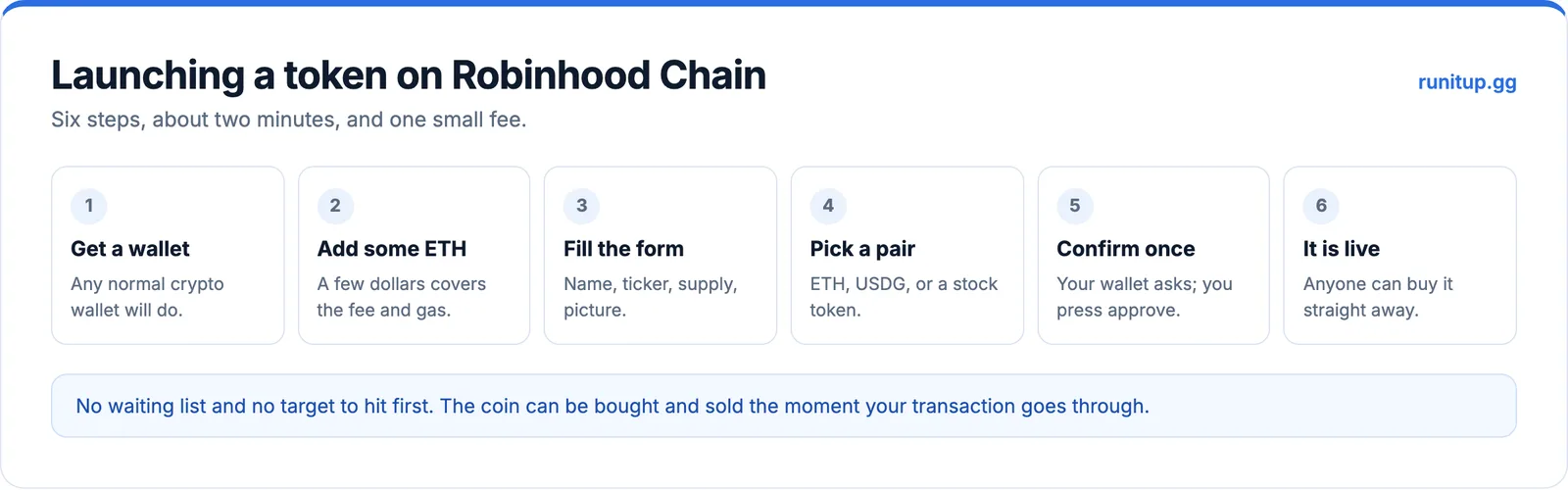
If you want to launch a token on Robinhood Chain, the honest version is that it takes about two minutes and costs a few dollars. There is no application to fill in, no waiting list, and nobody to ask for permission. You need a crypto wallet, a small amount of ETH, a name, and a picture.
This guide is written for people who are not developers. Every step below is something you do by clicking buttons on a website and pressing approve in your wallet. No code, no command line, no contracts to write. If you have ever bought a coin on an exchange, you already have the harder skill.
We will go through what the chain is, whether it suits what you are trying to do, what you need in front of you before you start, what it really costs, the six steps themselves, and the mistakes that cost people money afterwards. Read the money section even if you skip the rest.
What Robinhood Chain is, in plain words
A blockchain is a shared record of who owns what. Robinhood Chain is one of those records, built so that trading and settlement happen quickly and cheaply. It is a separate network, in the same way that a motorway is separate from the road outside your house.
The fee you pay to use it, which everyone calls gas, is paid in ETH. That is the same ETH you can buy on any exchange. You do not need a special coin just to move around on this chain, which is one less thing to explain to your buyers.
For your purposes, the chain is simply where your coin will live. It records that the coin exists, who holds it, and every trade anyone makes. You can see all of it on the public Robinhood Chain block explorer, which is a free website anyone can search.
Should you launch a token on Robinhood Chain?
It is worth being clear about what a coin actually is before you make one. A coin is a tradeable thing with a name and a supply. It is not a company, a promise, or a product on its own. What gives it value is that people want it, and nothing else.
That makes it a good fit for a few things. Community coins, where a group wants something of their own to trade. Jokes and memes, which live or die on attention. Small experiments, where you want to see whether an idea catches on before building anything serious.
It is a poor fit for raising money from people who expect a return. That is a regulated activity in most countries, and a coin does not stop it being one. If that is your plan, talk to a lawyer before you launch a token on Robinhood Chain, not after.
There is one more honest caveat. Most coins go to nearly nothing. If you launch a token on Robinhood Chain expecting it to make you rich, the base rate is against you. Launch because you want the thing to exist.
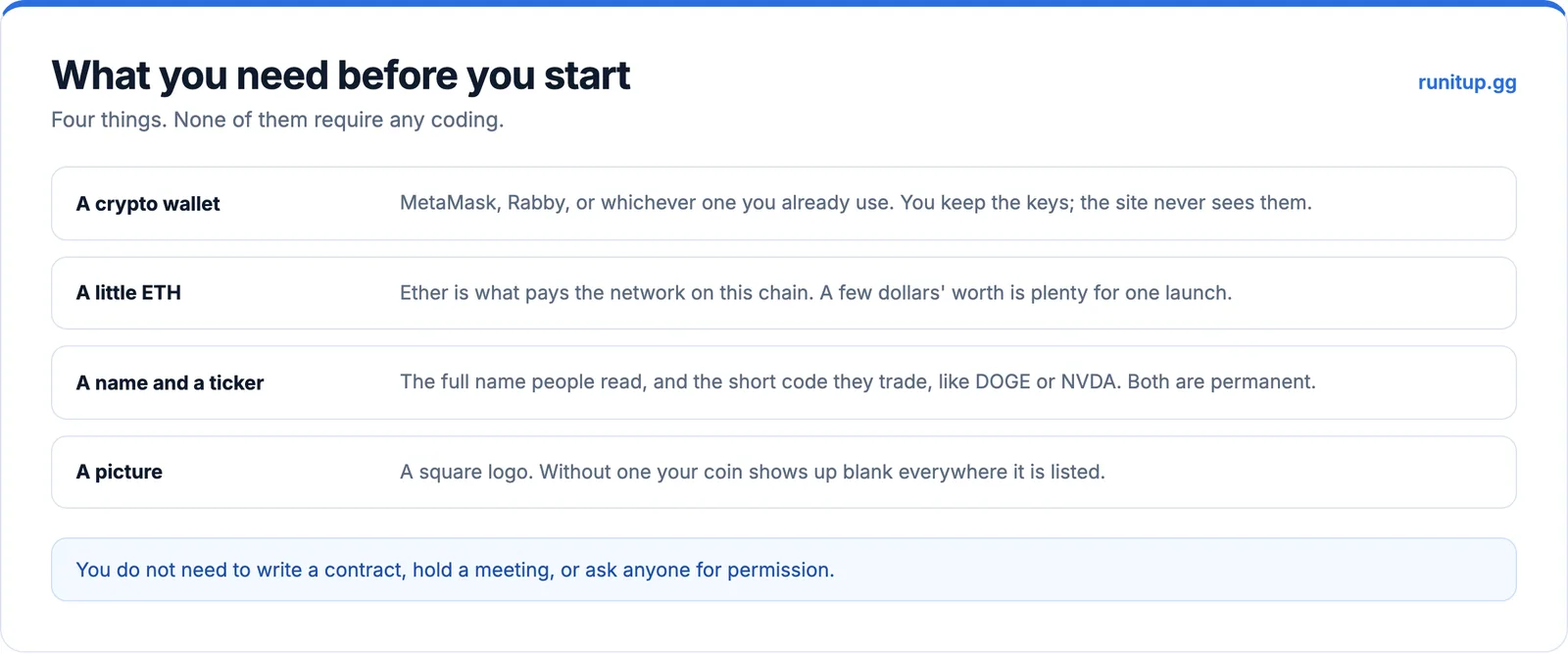
What you need before you launch a token on Robinhood Chain
Four things, and none of them are technical. Gather them first and the launch itself takes two minutes instead of twenty.
Setting up a Robinhood Chain wallet
A wallet is an app that holds your coins and signs for you. MetaMask and Rabby are the common ones, and both are free browser extensions. If you already use one, that is the wallet you will use here, and you do not need a second.
Your Robinhood Chain wallet is not a separate product you go and download. It is the same wallet you already have, pointed at a different network. When you open the launch page and press connect, the site offers to add the network for you. You press approve and it is done.
Write your recovery phrase on paper and keep it somewhere safe. Anyone who has those words has your money, and nobody can undo a transfer. No real support team will ever ask you for them.
Getting a little ETH into it
You need ETH on Robinhood Chain specifically, not on another network. Buying ETH on an exchange and sending it to the wrong network is the single most common way people lose their first attempt, so check the network name on the withdrawal screen before confirming.
How much? Enough for the launch fee and a bit of gas, which together are a few dollars at normal prices. If you also want to buy some of your own coin at the start, add that on top. There is no advantage to funding the wallet heavily.
A name, a ticker and a picture
The name is the full one people read, like Global Dollar. The ticker is the short code they trade, like USDG. Both are permanent once the coin exists, so read them back to yourself before you confirm. Typos are forever.
The picture should be square and simple enough to read at the size of a thumbnail. Without one, your coin shows up as a blank circle everywhere it is listed, which makes it look abandoned on day one.
What it costs to launch a token on Robinhood Chain
Three numbers matter, and only two of them are money leaving your pocket.
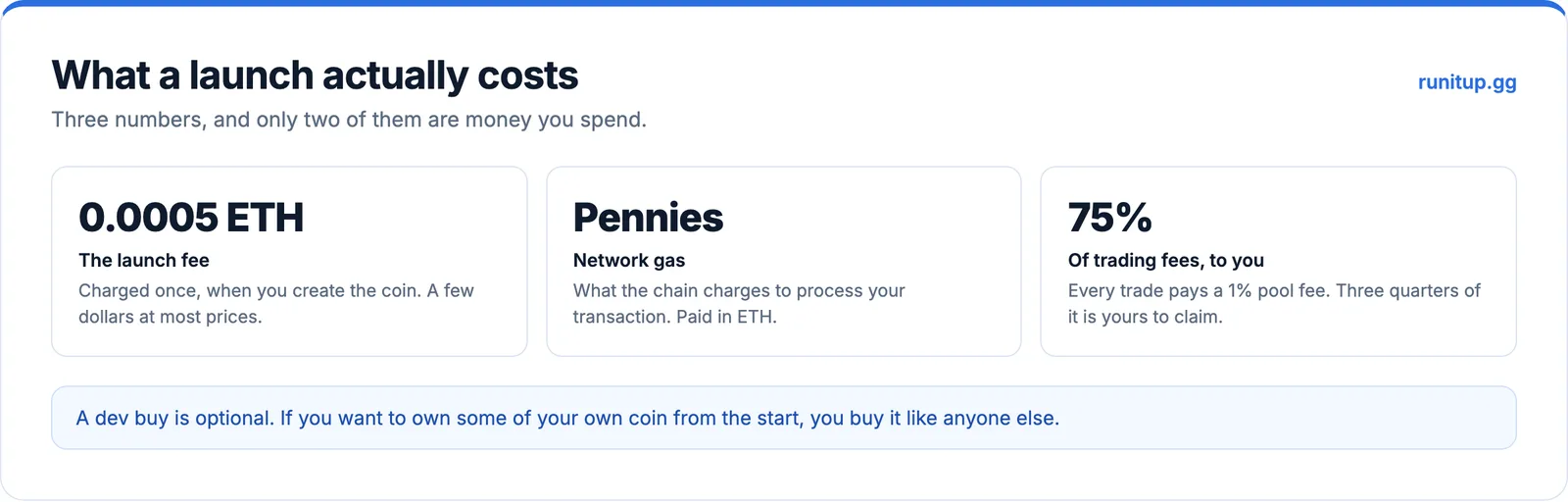
The launch fee is 0.0005 ETH, charged once when the coin is created. At most prices that is a few dollars. The exact amount in your currency is shown on the launch page before you confirm anything, so you never have to guess.
Gas is what the chain charges to process your transaction, and on this chain it is small. Budget a little more ETH than the fee itself and you will be comfortable.
The third number is money coming back to you. Every trade in your coin pays a pool fee of 1%, and three quarters of that fee is yours. It builds up as people trade and you claim it whenever you like.
Where creator fees come from
When someone buys or sells your coin, a slice of that trade is taken as a fee before the rest goes through. This is how trading works everywhere, not something added on top for you. The Uniswap documentation on pool fees explains the mechanism if you want the detail.
What is unusual is the split. Most of that fee goes to you as the person who made the coin, rather than to the platform. Our guide to collecting fees walks through how to claim what has built up.
Nobody gets paid if nobody trades. Creator fees are a share of activity, not a salary. A coin nobody buys earns nothing no matter how it was launched.
Six steps to launch a token on Robinhood Chain
Here is the whole process. Each step is one screen.
Step one: open the launch page
Go to the launch page and press connect. Your wallet pops up and asks whether you want to connect to the site. Approve it. If your wallet is on a different network, you will be asked to switch, and approving that is safe.
Step two: fill in the name, ticker and supply
Type the name and the ticker, and upload the picture. Then set the supply, which is how many coins will ever exist. You can pick anything from one up to ten billion.
The number matters less than people think. A billion coins at a low price and a million coins at a higher price are worth the same in total. Most people pick one billion because it looks familiar.
Step three: choose what your coin trades against
Every coin needs something on the other side of the trade. Your choices are ETH, a dollar-backed coin called USDG, or one of thirty tokenized stocks. The next section covers how to choose. If you are unsure, ETH is the ordinary answer.
Step four: decide whether to buy some yourself
There is an optional box for buying some of your own coin as part of the launch. This is called a dev buy, and it is normal. It is not free money. You pay the going rate like everyone else.
Some creators do it so they hold a stake from the start. Others skip it so nobody can accuse them of holding too much. Both are defensible, and buyers do look.
Step five: confirm in your wallet
Press the launch button and your wallet asks you to approve one transaction. Check the amount, then approve. If you chose a pair that is not ETH, there is a small approval step first, and your wallet will walk you through both.
Wait for the confirmation. It usually takes a few seconds.
Step six: check it is live
You land on your coin's page, with its price, its chart and its address. That address is the coin's permanent identity, and it is what you send to anyone who wants to buy. Search it on the block explorer and you will see your own launch sitting in the chain's history.
There is no waiting period and no target to hit before trading opens. Anyone can buy the moment your transaction confirms.
Choosing between ETH, USDG and tokenized stocks
This is the one decision you cannot change later, so it deserves a minute of thought.
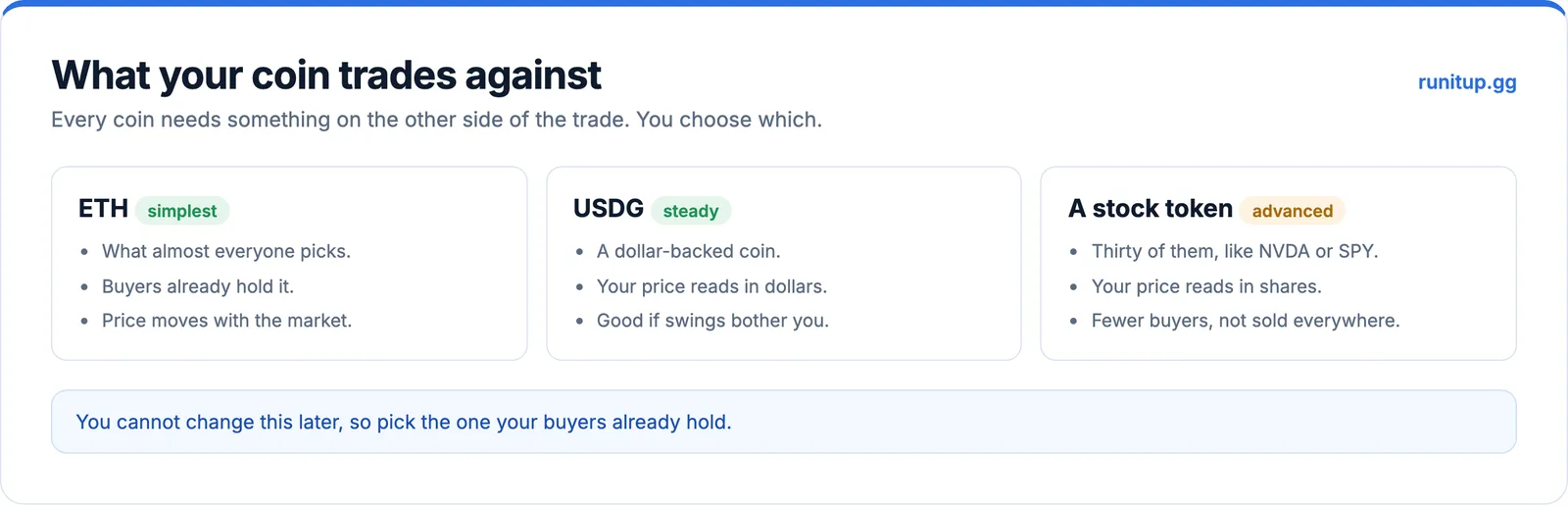
ETH is the default and the right answer for most people. Buyers on this chain already hold it, so nobody has to go and get something first in order to buy from you. Fewer steps between a person and a purchase means more purchases.
USDG is a dollar-backed coin, which means one of them is meant to be worth a dollar. Pairing with it makes your price read in dollars, so a buyer sees a number they understand without doing conversions in their head. It suits a coin where wild swings would be off-putting.
The third option is the unusual one on this chain. You can pair your coin with a tokenized stock, of which there are thirty, including NVDA, TSLA, AAPL and SPY. Your coin's price is then expressed in shares of that stock instead of in ETH or dollars.
That is a genuinely interesting thing to be able to do, and it is also the advanced path. Pools like these have fewer buyers, and tokenized stocks are not available to people in every country. Read our note on tokenized stocks before you pick one, and pick ETH if you are at all unsure.
What locked liquidity means for you
When your coin is created, it is paired with its other side in a pool, and that pool is what people trade against. The liquidity in that pool is locked permanently. There is no button, anywhere, for anyone, that takes it back out.
This matters because the most common way people get hurt in this corner of crypto is a rug pull, where whoever launched a coin removes the money backing it and leaves holders with something unsellable. Locked liquidity makes that particular move impossible, and buyers can check it themselves rather than taking your word for it.
The trade-off is that it applies to you too. You are not putting money in that you can later take out, and there is no undo. Our explanation of the liquidity lock covers exactly what is locked and how anyone can verify it.
One more thing worth knowing before you launch a token on Robinhood Chain: coins with a built-in tax on trades are paused at the moment while those contracts finish an audit. Ordinary launches, the kind this guide describes, are unaffected.
What happens after you launch a token on Robinhood Chain
The launch is the easy part. What you do in the first hour decides whether the coin has a life.
Claiming your share of the fees
Fees accumulate as people trade and sit there until you claim them. Nothing expires. You can leave them for a month and collect the lot, or claim as you go.
A quiet coin earns very little, and that is not a fault in the setup. It is simply what happens when there are no trades to take a fee from.
Getting people to actually see it
Nobody is browsing for new coins. If you do not tell people, your coin sits at zero trades forever, and that is the normal outcome for a launch nobody talks about.
Share the coin's address rather than a screenshot, because the address is what people need to actually buy. Post it where your community already is. A coin with a story and twenty real holders beats one with a clever name and none.
Price trackers usually pick up new coins automatically within minutes of the first trades. You do not have to apply anywhere.
Mistakes people make when they launch a token on Robinhood Chain
These are the ones that cost real money, in rough order of how often they happen.
Sending ETH to the wrong network. Check the network name twice on the exchange withdrawal screen. Funds sent to the wrong chain are usually gone.
Typos in the name or ticker. They cannot be edited afterwards because they are written into the coin itself. Read them out loud before confirming.
Picking an exotic pair without a reason. If your buyers hold ETH and you pair with something else, you have added a step to every purchase.
Launching with no picture and no plan to tell anyone. It takes five minutes to prepare both, and skipping them is the difference between a coin that gets looked at and one that does not.
Expecting the launchpad to bring buyers. It builds the pool, locks it, and pays you your share of the fees. Interest is your job.
Questions people ask before they launch a token on Robinhood Chain
How long does the whole thing take?
About two minutes of clicking once your wallet is funded. Getting ETH onto the chain in the first place is usually the slowest part, and that depends on your exchange.
Do I need to know how to code?
No. Nothing in this guide requires it. The contract behind your coin is a standard one that has already been written and audited; you are filling in the details, not building it.
Can I change the name or supply later?
No. Both are permanent. You can update the picture and the description that appear on the coin's page, but the name, ticker and supply are fixed once the coin exists.
Can I take the liquidity back out?
No, and this is deliberate. See the section above on locked liquidity. Anyone can verify the lock before they buy, which is exactly why it is worth having.
Is this available in my country?
The chain and the launch process are open to anyone who can reach the site. Tokenized stocks are a separate matter and are not offered everywhere, so check that before choosing one as your pair.
What happens if nobody buys it?
Nothing bad. The coin exists, the pool sits there, and you have spent a few dollars. There is no ongoing cost and nothing to cancel.
Once you have your wallet funded and your name settled, the rest is a short form and one approval. Start on the launch page when you are ready, and keep the address somewhere safe the moment it appears.