If you have been told that Uniswap V4 hooks are the big new thing in crypto trading and you still have no idea what one is, this is for you. No code, no jargon left standing, and no pretending the topic is harder than it is.
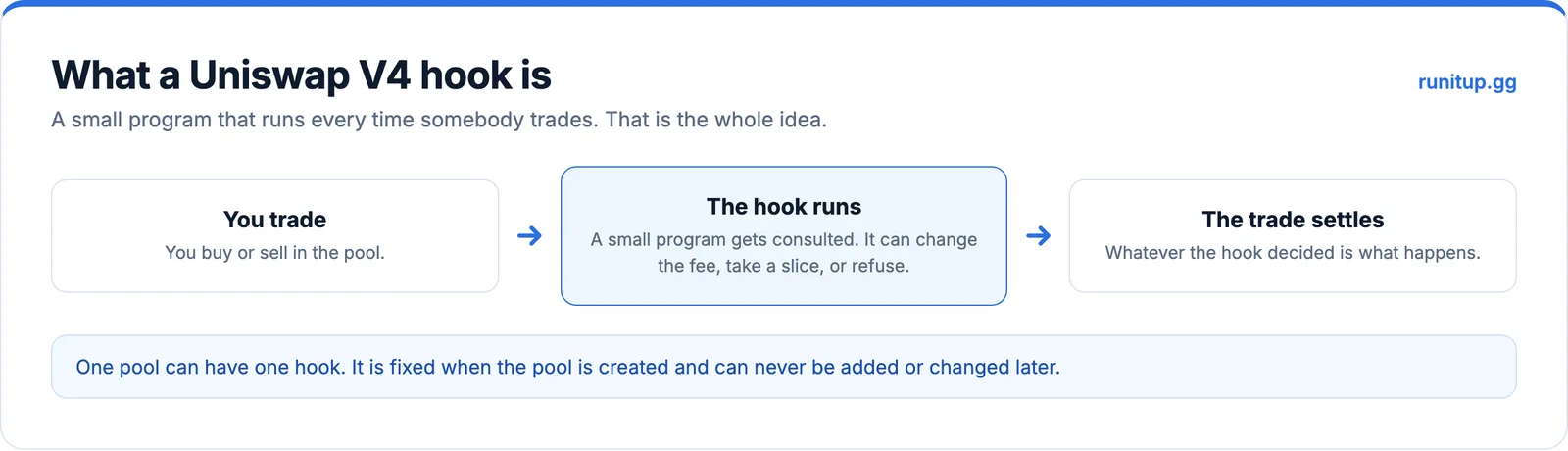
A V4 hook is a small program that runs every single time somebody trades. That is genuinely the whole idea. Everything else in this article is either an example of what that program might do, or a warning about what a dishonest one could do to you.
We will cover what they are, the five things they are actually used for, why most pools including ours run without one, and the one question worth asking before you buy a coin that has a hook attached to it.
What a liquidity pool does without a hook
Start with the thing a hook attaches to.
A liquidity pool is a pot with two things in it, say a new coin and some Ether. When you buy, you put Ether in and take coin out. The pot rebalances, and the price moves a little. Nobody is on the other side deciding whether to sell to you. The pot just follows its rule.
That rule has been the same for years and it is deliberately simple. Money in, tokens out, price adjusts, a small fee stays behind for whoever supplied the pot. Simple is a feature. There is very little that can surprise you.
Uniswap version four did not change that rule. It added a place to plug something in beside it.
A V4 hook is a small smart contract
The thing you plug in is a smart contract, which is just a program that lives on the blockchain and cannot be quietly edited afterwards.
The pool is told, at the moment it is created, that this particular program should be consulted during trades. From then on it is, every time, for everyone. That is the entire mechanism.
One pool can have one hook. One hook can serve any number of pools. And a pool created without a hook can never gain one later, which turns out to matter quite a lot for safety.
What V4 hooks are not
Three quick corrections, because the word gets thrown around loosely.
V4 hooks are not a coin. You cannot buy hooks, there is no hook token, and anybody offering to sell you one is selling you something else. They are a feature of how a pool is built.
They are not artificial intelligence and they do not make decisions in any interesting sense. A hook does exactly what its code says, every time, with no judgement involved. That predictability is the point.
And they are not new in the sense of untested. The idea shipped with Uniswap version four and has been running in public for a while now. What is genuinely new is how many people are writing them, which is the part worth being careful about.
Why V4 hooks exist at all
Before version four, anyone who wanted a pool to behave differently had to build a whole new exchange to get it. That is an enormous amount of work to change one rule.
V4 hooks were the answer to that. Instead of rebuilding the exchange, you write a small program, attach it to your pool, and the rest of the machinery stays as it was. Uniswap's own documentation on hooks describes them as contracts that run at specific points in a pool's life.
The practical effect is that pools stopped being one-size-fits-all. A pool holding something that tracks a real share can behave differently from a pool holding a joke coin, without either of them leaving the same exchange.
The five things V4 hooks are actually used for
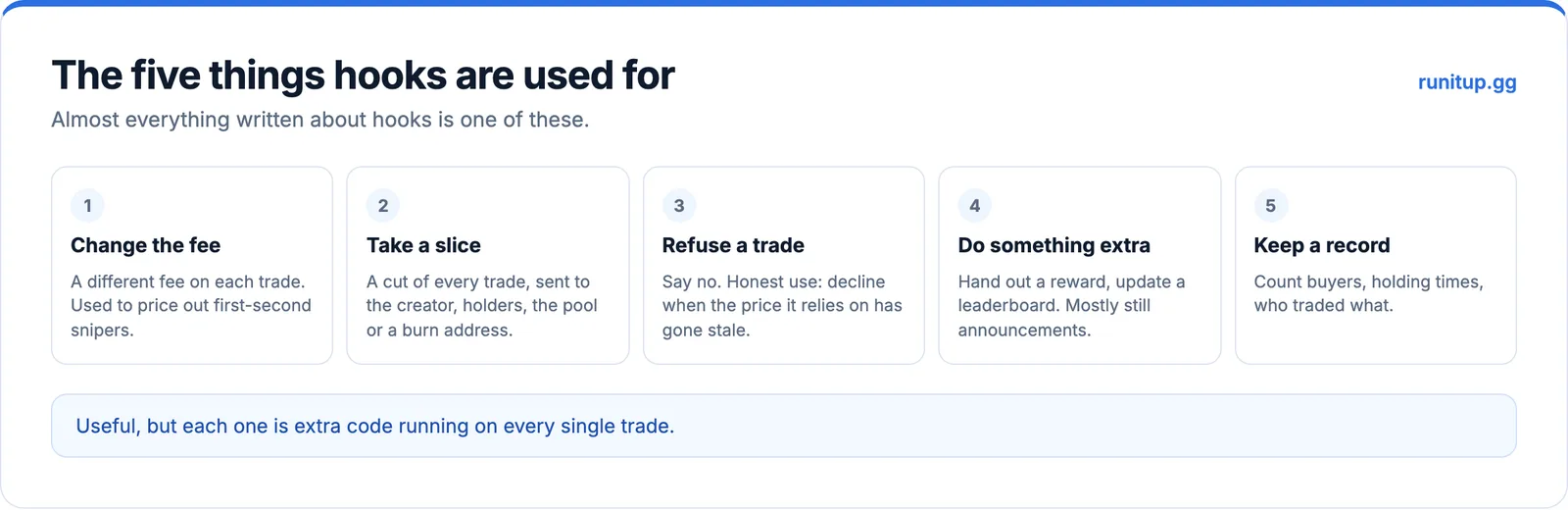
Almost everything you will read about V4 hooks is one of these five.
Charging dynamic fees
Ordinarily a pool has one fee, fixed forever. A hook can set dynamic fees instead, which means the fee is decided fresh on each trade.
The common use is discouraging the people who buy in the first seconds of a launch with automated software, then sell into the people arriving afterwards. Start the fee painfully high, let it fall to normal over a few minutes, and that trade stops being worth making.
Taking a slice of every trade
A hook can take a cut of each trade and send it somewhere. That is how a coin with a built-in tax works: buy, and a percentage is skimmed off before you receive anything.
Where it goes is up to whoever wrote the hook. Common destinations are the creator, the pool itself, existing holders, or a burn address, which is a wallet nobody holds the keys to.
Refusing trades that should not happen
A hook can look at a trade and say no.
That sounds sinister and sometimes is, but the honest version matters. If a pool holds something tracking a real share, and the price information it relies on has gone stale, letting people keep trading against a stale number is how somebody gets robbed. A hook can simply decline until the number is fresh again.
Doing something extra when you trade
Because the hook runs during the trade, it can do other work at the same time. Handing out a reward, updating a leaderboard, recording that you were early.
This is the category with the most imagination in it and the least actual usage. Most of what has been announced here does not exist yet.
Keeping a record
A hook sees every trade, so it can keep count of things the pool itself does not track. How many distinct buyers there have been, how long somebody held, how much a given wallet has traded.
What V4 hooks look like in one real trade
An example makes this concrete. Say you buy fifty dollars of a new coin.
In a pool with no hook, the sequence is short. Your fifty goes in, the pool works out how much coin that buys at the current price, one percent stays behind as the fee, and you receive the rest. Nothing else is consulted, and the outcome is the same as it would be for anybody else trading the same amount.
Now put a fee schedule in the same pool. Your fifty goes in, and before anything is calculated the pool asks the hook one question: what is the fee for this trade, right now? If the coin launched four seconds ago the answer might be very high, and you would receive noticeably less coin. If it launched an hour ago the answer is the ordinary one percent and your trade looks identical to the first case.
That is the shape of it. V4 hooks do not replace the pool's arithmetic, they answer questions the pool asks along the way, and they can decline the trade entirely.
Which questions get asked is fixed when the pool is created. This is why V4 hooks cannot be bolted on later, and why a plain pool stays plain for as long as it exists.
Why most pools, including ours, have no hook at all
Here is the part that gets left out of the excited articles. V4 hooks are optional, and most pools do not have one.
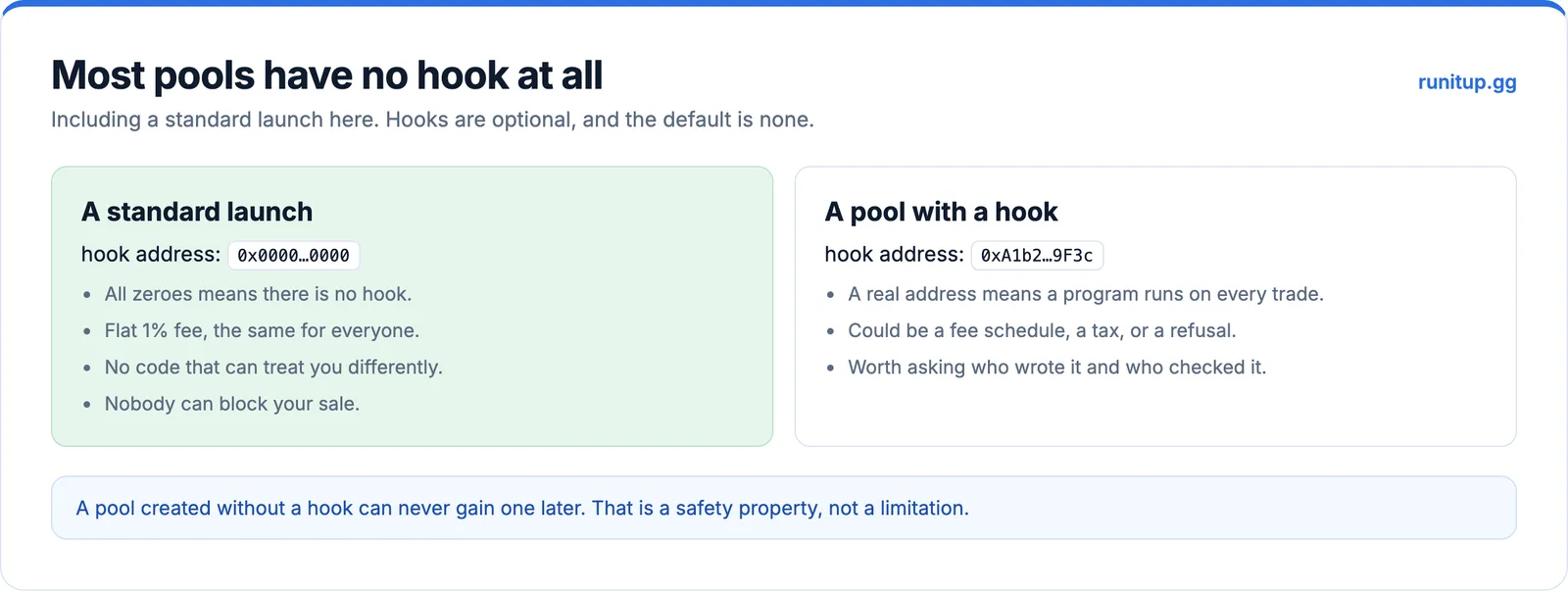
That includes ours. A standard launch here opens a pool with a flat one percent fee and no hook attached at all. You can verify that in our public configuration, where the hook field is an address of nothing but zeroes, which is how the chain says "there isn't one".
This is a deliberate choice rather than an oversight. Every one of these V4 hooks is extra code running on every trade, and extra code is extra that can go wrong. For an ordinary coin that wants to be bought and sold, a plain pool does the job and has years of use behind it.
The rule of thumb is that a hook should earn its place. If you cannot say what it does in one sentence, it is not earning it.
The V4 hooks we have written, and why they are switched off
We have written two V4 hooks ourselves, which makes this less theoretical.
The first handles coins with a built-in tax. A creator picks a rate, the tax is taken in the coin itself rather than in what you paid with, and it is split between the creator, the pool, the holders and the burn address. Nothing is paid out during the trade itself, because a payment that fails should never be able to take somebody's trade down with it.
That one is paused on both chains while the contracts finish an audit. Taxed launches are unavailable until that is done. Ordinary launches are completely unaffected, which is why the site still works normally.
The second is the decaying fee described earlier, for discouraging the first-second snipers. Its schedule is written once when the coin launches and there is no way to change it afterwards. No setter, no restart, no admin button. That is on purpose: a creator who could switch an eighty percent fee back on after people had bought would be holding a rug pull button, and the safest number of people holding one of those is none.
Who writes V4 hooks, and why that matters
A hook is written by whoever launched the pool, or by a team whose work they borrowed. That is the whole quality-control process, and it is worth sitting with for a second.
When you trade against a plain pool, you are trusting code that thousands of people have read and that has held billions of dollars for years. When you trade against a pool with an unfamiliar hook, you are additionally trusting whatever that particular person wrote last week.
Both can be fine. They are not the same bet, and the difference is invisible unless you go and look. A widely used hook that several teams have audited sits much closer to the first case than the second.
This is also why reputable launchpads are conservative here. The temptation is to ship clever machinery because it demos well. The cost of getting it wrong is somebody's money, and it is never the person who wrote the hook who pays it.
How V4 hooks can be used against you
Now the part worth actually remembering.
The honeypot problem
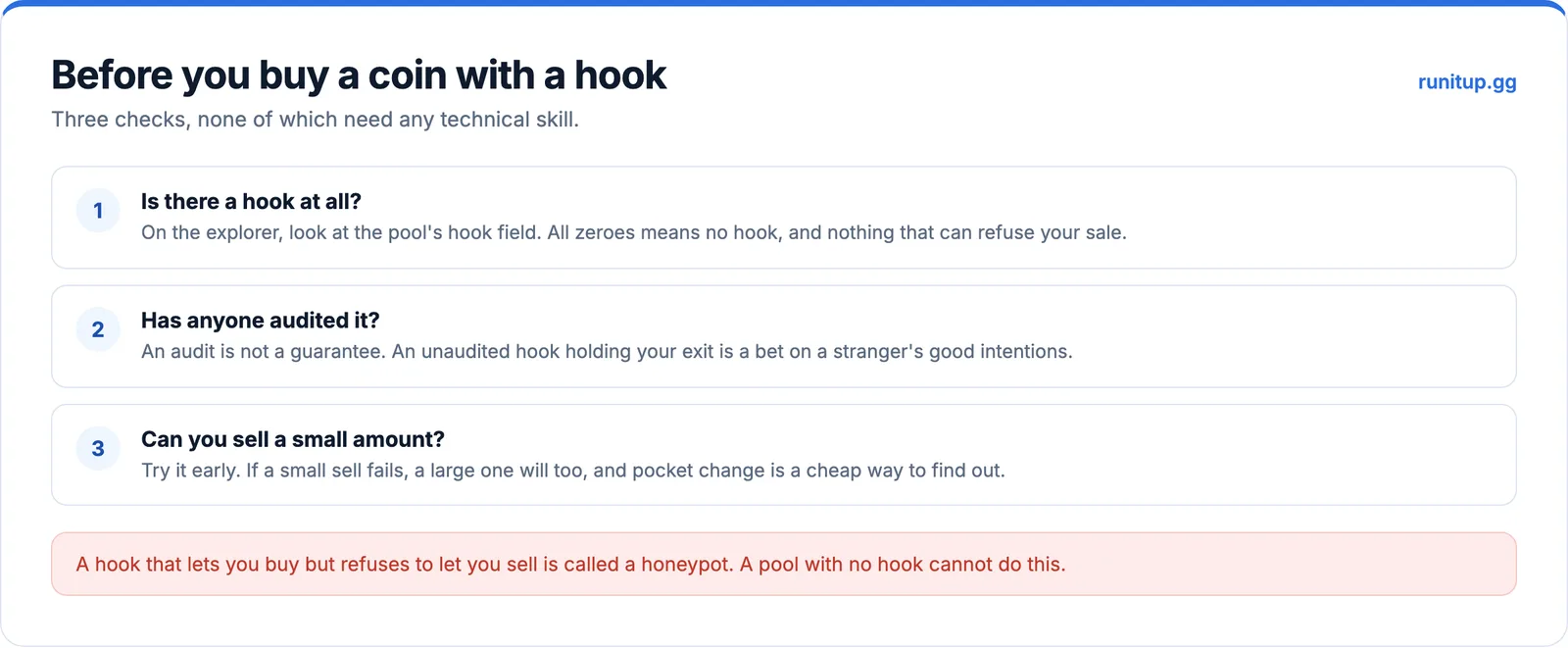
Because V4 hooks can refuse a trade, a dishonest one can allow buying and refuse selling. You put money in, you watch the number go up, and when you try to leave, the trade fails. That is called a honeypot, and hooks make it straightforward to build.
A plain pool without a hook cannot do this. There is no code in it capable of treating you differently from anyone else.
What to check before you buy
Three things, none of which need technical skill.
Ask whether the pool has a hook at all. On a coin's page or a block explorer, a pool with no hook shows that field as all zeroes. No hook means nobody can block your sale.
If there is a hook, ask whether anyone has looked at it. An audit is not a guarantee, but an unaudited hook holding your exit is a bet on a stranger's good intentions.
And try a small sell early. If you cannot sell a small amount, you will not be able to sell a large one, and finding that out with pocket change is far better than finding it out later.
When a safety scanner cries wolf
One practical warning. Some automated safety scanners have not caught up with V4 hooks and the newer pool format, and will flag perfectly ordinary coins as dangerous simply because they do not understand the newer pool format.
So a red flag from a scanner is a reason to look closer, not a verdict on its own. Check what the scanner actually objected to. Quite often the answer is that it could not read the pool at all.
Do you need V4 hooks for your own coin?
Almost certainly not, and that is not a dodge. Most coins never need V4 hooks at all.
If you are launching a coin so a community has something of its own to trade, a plain pool is the right tool. It is cheaper, it is better understood, and buyers do not have to trust anything extra. Our guide to the venues covers what each option gives you.
There are real reasons to want V4 hooks. A built-in tax that funds something. A pool quoted in a tokenized stock that needs to behave sensibly when the market is shut. Serious anti-sniper protection on a launch you expect to be attacked.
What is not a reason is that V4 hooks sound advanced. Every extra piece of machinery is another thing a buyer has to trust, and trust is the scarcest thing a new coin has.
Questions people ask about V4 hooks
Are hooks a Uniswap-only thing?
The name is. The idea behind V4 hooks, custom code attached to a pool, exists elsewhere under other names, but hooks in this specific sense are a Uniswap version four feature.
Can a hook be added to my pool later?
No. Whether a pool has a hook, and which one, is fixed when the pool is created and cannot be changed afterwards. This is a safety property, not a limitation.
Can a hook steal the tokens in the pool?
Badly written or deliberately malicious V4 hooks can do serious damage, which is why what the hook is allowed to touch matters so much. A pool with no hook has no such exposure.
Does a hook make trading more expensive?
Slightly, because V4 hooks are extra code and that costs a little to run on every trade. Whether that is worth it depends entirely on what it is doing for you.
Why are your taxed launches still paused?
Because the contracts are being audited and we would rather be late than sorry. Ordinary launches work normally in the meantime.
Can I tell what a hook does without reading code?
Sometimes. A verified contract on the block explorer will often have readable comments, and a well-run project will say plainly what its hook does. If nobody will explain it in a sentence, treat that as the answer.
Are V4 hooks the reason some coins cannot be sold?
They are one reason, and the newest one. Coins have been built to block selling since long before version four existed, using other tricks inside the token itself. The check is the same either way: try a small sell early.
How do I see whether a pool has one?
Look at the pool's details on a block explorer. There is a hook field, and for the overwhelming majority of pools it reads as an address made entirely of zeroes.
If you are launching something yourself, the honest default is the plain pool: open it on the launch page, leave the clever machinery alone, and spend the effort you saved on telling people the coin exists.