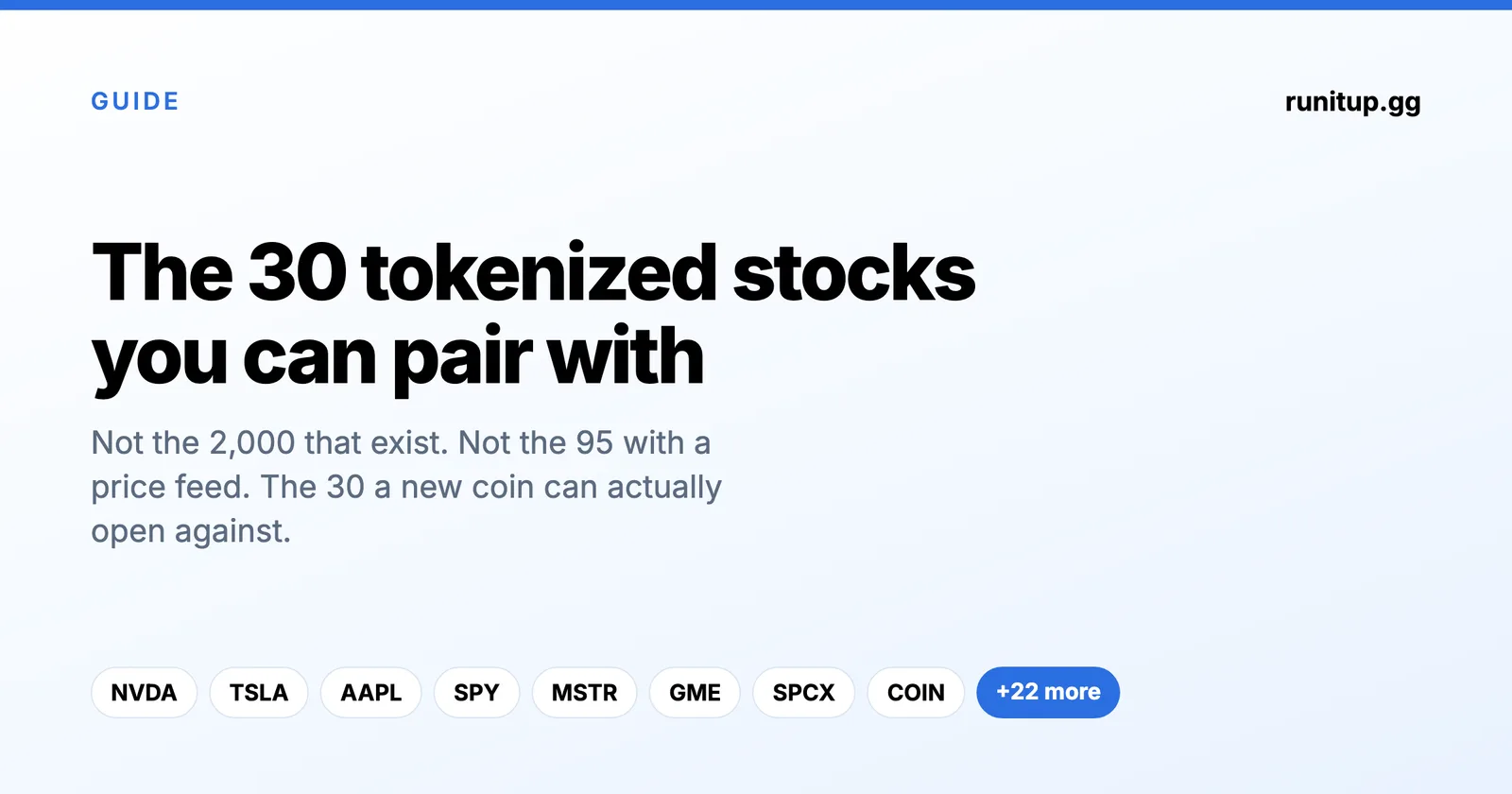
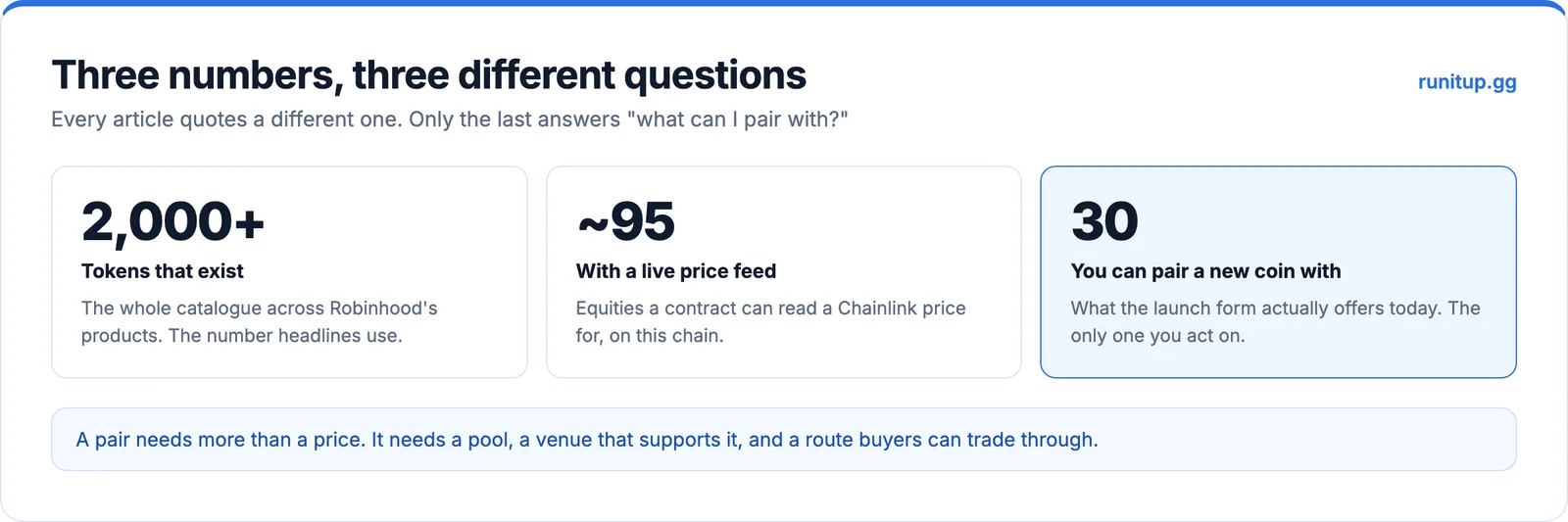
If you want to pair a new coin with tokenized stocks on Robinhood Chain, the number you need is thirty. Not the two thousand you will read on one page, and not the ninety-five you will read on another. Thirty is how many you can actually put on the other side of a new pool today, and this guide lists every one of them.
Those other numbers are not wrong. They are answers to different questions. One counts what exists on the chain, another counts what has a live price feed, and thirty counts what a launchpad can open a pool against. Most articles about tokenized stocks never mention that these are three separate things.
This is written for someone about to launch a coin and wondering whether to quote it in Apple instead of Ether. No code, no jargon left unexplained. We will go through the list, what a stock pair does to your coin day to day, when it is a good idea, and the two things that catch people out afterwards.
Three numbers, three different questions
The first number is the catalogue. Robinhood has expanded its stock token range well past two thousand instruments across its products. That is the answer to "what has been tokenized", and it is the number headlines use.
The second number is the priced set. Around ninety-five equities carry a live Chainlink price feed on Robinhood Chain, which Robinhood's own chain documentation describes in detail. A price feed is what lets a contract read what a share is worth without asking a person. That is the answer to "what can other software safely use".
The third number is thirty. That is the answer to "what can I pair a brand new coin with on this launchpad right now", and it is the only one that matters when you are standing in front of the launch form. It is smaller because a pair needs more than a price. It needs a pool, a venue that supports it, and a route buyers can actually trade through.
If a page quotes you one of the bigger numbers as though you could pair with all of them, it is answering a question you did not ask.
What stock tokens actually are
A stock token is an ordinary token on the chain whose value is meant to track a real share. It is not the share. You do not get a vote, you are not on the company's register, and the rights an ordinary shareholder has are not attached.
What you get is a token with a price feed pointed at the real thing. For the purposes of pairing a coin, that is enough, because a pool only needs to know what the other side is worth.
The 30 tokenized stocks you can actually pair with
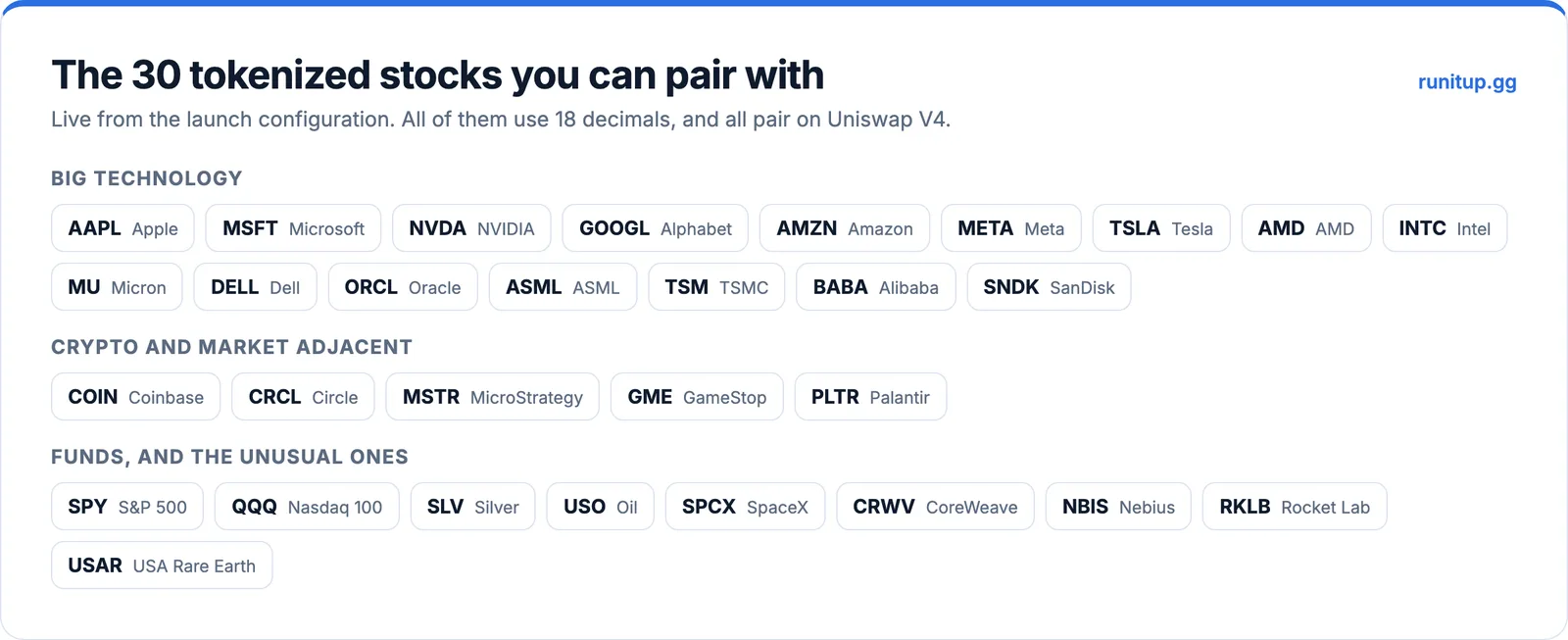
Here is the live list of tokenized stocks, straight from the launch configuration.
The big technology names
AAPL for Apple, MSFT for Microsoft, NVDA for NVIDIA, GOOGL for Alphabet, AMZN for Amazon, META for Meta Platforms, TSLA for Tesla, BABA for Alibaba, AMD, INTC for Intel, MU for Micron, DELL, ORCL for Oracle, ASML, TSM for TSMC, and SNDK for SanDisk.
These are the tokenized stocks most people recognise, and they are the ones most likely to mean something to a buyer who is not deep in crypto.
The crypto and market adjacent ones
COIN for Coinbase, CRCL for Circle, MSTR for MicroStrategy, GME for GameStop, and PLTR for Palantir.
These carry a story that crypto audiences already follow, which is often the point of choosing them. A coin quoted in MicroStrategy reads as a statement rather than a settings choice.
The funds, and the unusual ones
SPY tracks the S&P 500 and QQQ tracks the Nasdaq 100. SLV follows silver and USO follows oil. Then there are the newer names: SPCX for SpaceX, CRWV for CoreWeave, NBIS for Nebius, RKLB for Rocket Lab, and USAR for USA Rare Earth.
All thirty use eighteen decimal places, the same as Ether, so nothing behaves oddly in the arithmetic. That is a small mercy, and not true of every token on every chain.
Why the pair has to be on Uniswap V4
The launch form offers three venues. For tokenized stocks, only one of them works, and that is Uniswap V4.
This is not a preference we express, it is enforced by the contracts themselves. Our note on AMM venues covers what each one does. The older venue adapters refuse tokenized stocks outright, so a launch submitted with a stock pair anywhere else simply fails and you have spent gas learning that.
The reason is that Uniswap V4 supports hooks, which is code that runs on every single trade. A pair that tracks a real world asset needs that. Only a hook can do things like refuse a trade when the price being quoted has gone stale, and a stale price on a real asset is how people get hurt.
If you pick a stock in the form, the venue narrows itself. You do not have to remember this. It is worth knowing why it happened.
How the Chainlink price feed sets your coin's price
Every one of these tokenized stocks has a Chainlink price feed, and that feed is doing quiet work in the background.
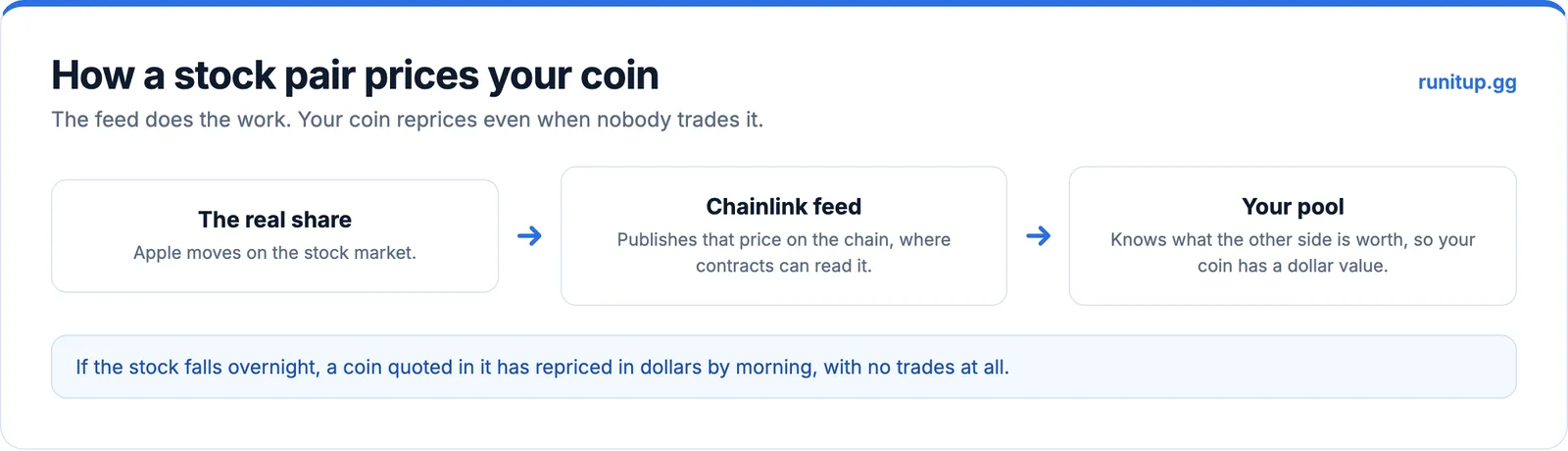
A price feed is a piece of infrastructure that publishes what something is worth, on the chain, where contracts can read it. Chainlink's documentation on price feeds explains how the numbers get there. Without one, a contract has no idea what a share of Apple costs. With one, it does, and it can act on that.
For your coin, this means the pool always knows the dollar value of the thing on the other side of it. Your coin's price is expressed in shares, but the underlying maths has a real number to work from.
It also means your coin's dollar price moves when the stock moves, even if nobody trades your coin at all. If Apple falls four percent overnight, a coin quoted in Apple has quietly repriced in dollars by morning. That is the part people do not expect.
What a stock pair does to your coin day to day
Pairing with tokenized stocks changes three things, and all three surprise someone eventually.
Your price reads in shares, not dollars
A buyer looking at your coin sees its price denominated in the stock. That can be a feature, because it is memorable and it makes your coin feel connected to something. It can also be friction, because a person has to do a conversion in their head to know what they are spending.
The stock market closes, your coin does not
Tokenized stocks can be bought and sold on the chain at any hour. The machinery behind them that creates and destroys tokens runs on a schedule, roughly Monday through Saturday in European hours.
The practical effect is that your pool keeps trading through the weekend while the thing it is quoted in is standing still. Prices can drift during those hours in ways that would not happen during the week.
Splits and dividends move the ground underneath
This is the detail almost nobody writes about. When the underlying company pays a dividend or splits its stock, the token does not change the number in your wallet. Instead a multiplier on the contract changes how many shares each token represents.
Your raw balance stays the same. What each unit is worth changes. Price feeds already account for this, so the pool is fine, but any tool that reads only the balance and assumes it means shares will quietly report the wrong thing. If you build anything that counts these tokens, read the multiplier too.
Choosing a quote asset that suits your coin
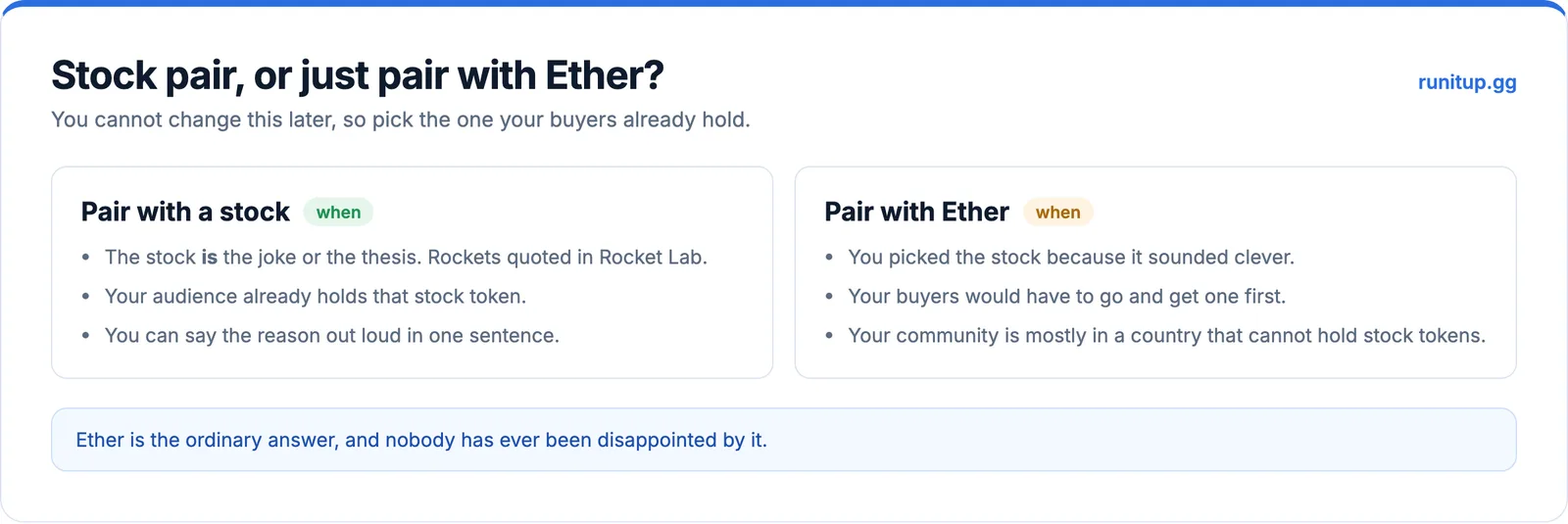
A quote asset is just the thing on the other side of your pool, and our guide to tokenized stocks goes further into the mechanics. Picking one is the only decision in the launch form you cannot undo later, so it deserves a moment.
When a stock pair is the right call
Pair with tokenized stocks when the stock is the joke, or the thesis. A coin about rockets quoted in Rocket Lab, a coin about silver quoted in silver: the pair is doing narrative work that a plain Ether pair cannot do.
When your audience already holds those tokenized stocks, pairing with them removes a step between the buyer and a purchase.
When it is the wrong call
When you chose it because it sounded clever. Fewer people hold tokenized stocks than hold Ether, so every buyer who does not have one must go and get one first. Every extra step costs you buyers.
If you cannot name the reason out loud in one sentence, pair with Ether. It is the ordinary answer and nobody has ever been disappointed by it.
Who can actually hold these
This is the part to read before you build a plan around tokenized stocks.
Tokenized stocks are not registered under United States securities law, and they cannot be offered to United States persons. Robinhood's own documentation also points them away from the United Kingdom, and other jurisdictions are restricted too.
That is a real constraint on your buyers, not a technicality. If your community is mostly American, a stock-paired coin asks them to hold something many of them cannot get, and your pool will be thin because of it.
None of that stops the pool existing or trading. It does change who can comfortably participate, and pretending otherwise would be dishonest.
Mistakes people make with tokenized stocks
In rough order of how often they happen.
Assuming any stock can be a pair. Two thousand instruments exist somewhere in the product range. Thirty are pairable here. Check the list before you promise your community a pair.
Picking a stock nobody in the audience holds. The pair is only convenient if your buyers already have the token. Otherwise it is a hurdle you built yourself.
Forgetting the pair is permanent. You cannot re-quote a pool later. A coin launched against a stock is quoted in that stock for as long as it exists.
Reading balances without the multiplier. Any dashboard that counts these tokens and ignores the shares-per-token multiplier will drift away from reality after the first corporate action.
Ignoring who can buy. If most of your people cannot hold the quote asset, you have chosen a pair that excludes your own audience.
Liquidity is thinner on tokenized stocks pairs
This is the practical trade-off, and it is worth understanding before you commit.
Liquidity means how much can be bought or sold before the price moves a lot. A deep pool absorbs a large order quietly. A thin one lurches. Pools quoted in tokenized stocks are thinner than pools quoted in Ether, simply because fewer people hold the quote asset in the first place.
What that feels like in practice: a buyer putting in a few hundred dollars may move your price more than they expected, and your chart will look more jagged than a comparable Ether pool. Neither is a fault in the pool. It is arithmetic.
There is a second-order effect people miss. When a pool is thin, the gap between what a buyer pays and what a seller receives widens, and traders who watch for that will avoid the pool, which keeps it thin. Early liquidity is partly a self-fulfilling prophecy, and the quote asset you choose is one of the few levers you have over it.
None of this argues against tokenized stocks. It argues for choosing one your audience already holds, so the pool has a reason to deepen.
What happens when the stock gaps
Shares do not always move smoothly. They gap: the price jumps between one session's close and the next one's open, usually on news or earnings.
Your pool does not pause for that. If the company you paired with reports badly and the share opens down eight percent, the dollar value of everything on the other side of your pool has moved before anyone in your community has woken up. Your coin's price in shares has not changed at all, which is the confusing part.
Traders who understand tokenized stocks will read this correctly. Traders who do not will see a dollar chart that dropped for no reason they can point at, and some of them will assume something went wrong. If you pair with a stock, expect to explain this at least once.
Questions people ask about tokenized stocks
Do I own the actual share?
No. You hold a token whose value tracks the share and whose price comes from a Chainlink feed. The rights that come with owning equity are not part of the token.
Can I pair with a stock that is not on the list?
Not on the launchpad. The thirty tokenized stocks above are what the launch configuration exposes as pairs today. The list can grow, so check it at launch time rather than trusting a screenshot.
Does my coin's price change when the market is shut?
Your coin trades whenever someone trades it. Its dollar value also moves whenever the underlying stock moves, including gaps that happen while the market is closed.
Is a stock pair riskier than an Ether pair?
It concentrates a different risk. With Ether you are exposed to crypto. With a stock you are exposed to one company, plus the restrictions on who can hold the token. Neither is safe; they are differently unsafe.
Why is my pool thinner than an Ether pool?
Because fewer people hold the quote asset. A pool can only be as deep as the people willing to put the other side in, and tokenized stocks are held by a smaller group than Ether is.
What happens to my coin if the company has bad news?
The dollar value of your pool's other side moves with the share. Your coin's price measured in shares does not change, but the price a person reads in dollars does, without a single trade in your coin.
Do dividends from tokenized stocks reach my pool?
Not as a payment. No cash arrives in the pool and no extra tokens appear in anyone's wallet. Instead the contract adjusts how many shares each token represents, and the price feed reflects that adjustment automatically.
The effect is that the value sitting on the other side of your pool keeps tracking the real holding, while the raw token count stays where it was. It is a tidy design, and it is the single most common thing people get wrong when they write tools that read balances of tokenized stocks.
Why only thirty when the chain has so many more?
Because a pair needs a venue, a pool and a route, not just a price. Thirty is what currently has all of that on this launchpad.
If a stock pair still fits after all of that, the list above is where to start, and the launch page shows the live options the moment you connect. If it does not fit, pair with Ether, follow the six steps to launch a token on Robinhood Chain, and spend the saved effort on telling people the coin exists.