Picking a Robinhood Chain launchpad used to be easy, because there was only one that mattered. Now there are more than a dozen, and they disagree about almost everything: whether your coin starts on a bonding curve, how much of every trade reaches you, who can touch the liquidity, and whether you get paid automatically or have to come back and claim.
This guide compares the nine that are actually live and trading, using figures taken from each platform's own documentation or read straight off the chain on 23 September 2026. News articles and listicles were only used to find which platforms exist, never for a number.
One thing up front, so you can weigh everything below: we run RunItUp, which is one of the nine. We have tried to be as blunt about where others beat us as about where we think we win. Two of them pay creators a bigger share than we do, and the biggest one pays in a cleaner way on one point. You will see both.
What a Robinhood Chain launchpad actually does
A launchpad is a website plus a set of contracts that turns "I have a name, a ticker and an image" into a coin people can trade, in one transaction. You fill in a form, pay a small fee, sign once, and the platform deploys the token and makes it tradable.
Every Robinhood Chain launchpad does that part. Where they differ is everything that happens after the first trade, and those differences decide how much a creator earns, how much a trader pays, and how much anyone has to trust the platform.
Four questions separate them cleanly. Ask them of any launchpad, including ours.
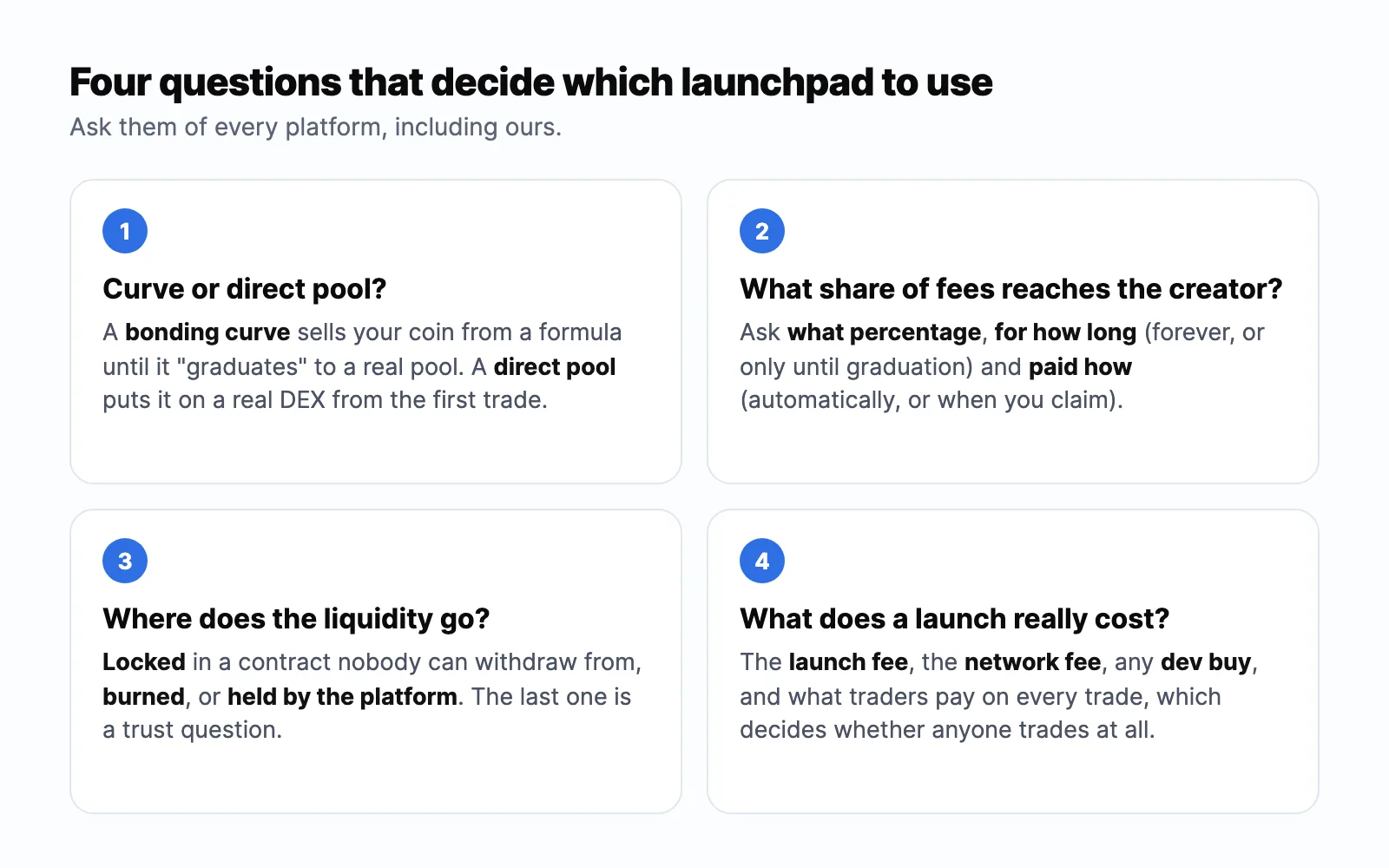
Bonding curve or direct pool
A bonding curve is a vending machine for a token. It holds the supply and sells from a formula, with the price rising as people buy. When enough has been bought, the coin "graduates" and moves into a real pool on a decentralised exchange.
A direct pool skips that stage. The coin goes straight into a real pool on Uniswap or a similar exchange, and the very first trade happens there.
Neither is better in the abstract. A curve gives an early price that nobody can move with a big deposit; a direct pool means there is no second phase to fail and the coin is on DEX screens from minute one. We wrote a whole piece on the trade-offs: bonding curve vs liquidity pool.
Creator fees: how much, for how long, and paid how
Almost every platform charges traders a fee and gives the creator a share. The share alone is not the whole answer. Ask for how long it lasts, what asset it arrives in, and whether it lands in your wallet or waits for you to claim it.
Where the locked liquidity goes
The money in a coin's pool is what lets people sell. If someone can withdraw it, they can empty the pool and leave holders with a coin nobody can sell. Good platforms put that position somewhere nobody can withdraw from, ever. Every platform below that states its policy says the liquidity is locked for good. That is now the minimum, not a feature.
What a launch really costs
The launch fee is the smallest number here. What matters more is what traders pay on every trade, because that decides whether anybody trades your coin at all, and every trade after that is where the creator's money comes from.
Every Robinhood Chain launchpad compared
Here is the whole field on one table. "Trader fee" is what a trader pays on a normal trade after any launch window has passed. "Creator share" is the creator's slice of that fee.
| Launchpad | Model | Launch fee | Trader fee | Creator share | Creator is paid |
|---|---|---|---|---|---|
| RunItUp | Direct pool (Uniswap V3, SushiSwap V3 or V4) | 0.0005 ETH | 1% | 75% of the fee, forever | Automatically, hourly |
| Pons V2 | Bonding curve, graduates to Uniswap V4 | 0.0005 ETH | 1%, plus optional creator tax up to 10% | 70% of the base fee plus all of the tax | Balance you withdraw |
| hood.fun | Bonding curve, graduates to Uniswap V3 | Gas only, plus a migration fee | 1% | 80% (ETH side of fees after graduation) | Claim, or pay holders instead |
| LetsCash | Direct pool (Uniswap V4) | Not stated | 1%, 3%, 5% or 10%, creator's choice | All but the platform's 0.3% | Claim |
| NOXA Fun | Direct pool (Uniswap V3) | Free | 1% | 50% | Claim, in ETH |
| o1 Launchpad | Direct pool (Uniswap V4) | 0.001 ETH | 1% | 50% | Claim |
| Bankr | Direct pool (Uniswap V4, Doppler) | Not stated | 1.75% all-in | 0.665% of each trade | Claim |
| Bags | Bonding curve, graduates to Uniswap V4 | 0.02 ETH | 2% | 1% of each trade | Claim |
| Pools.trade | Auction or bonding curve, Uniswap V4 | None | 0.25% | Optional, off by default | Claim |
Numbers turn into something you can feel once you put a trade behind them. Here is what happens to $1,000 of trading on each platform, at standard settings.
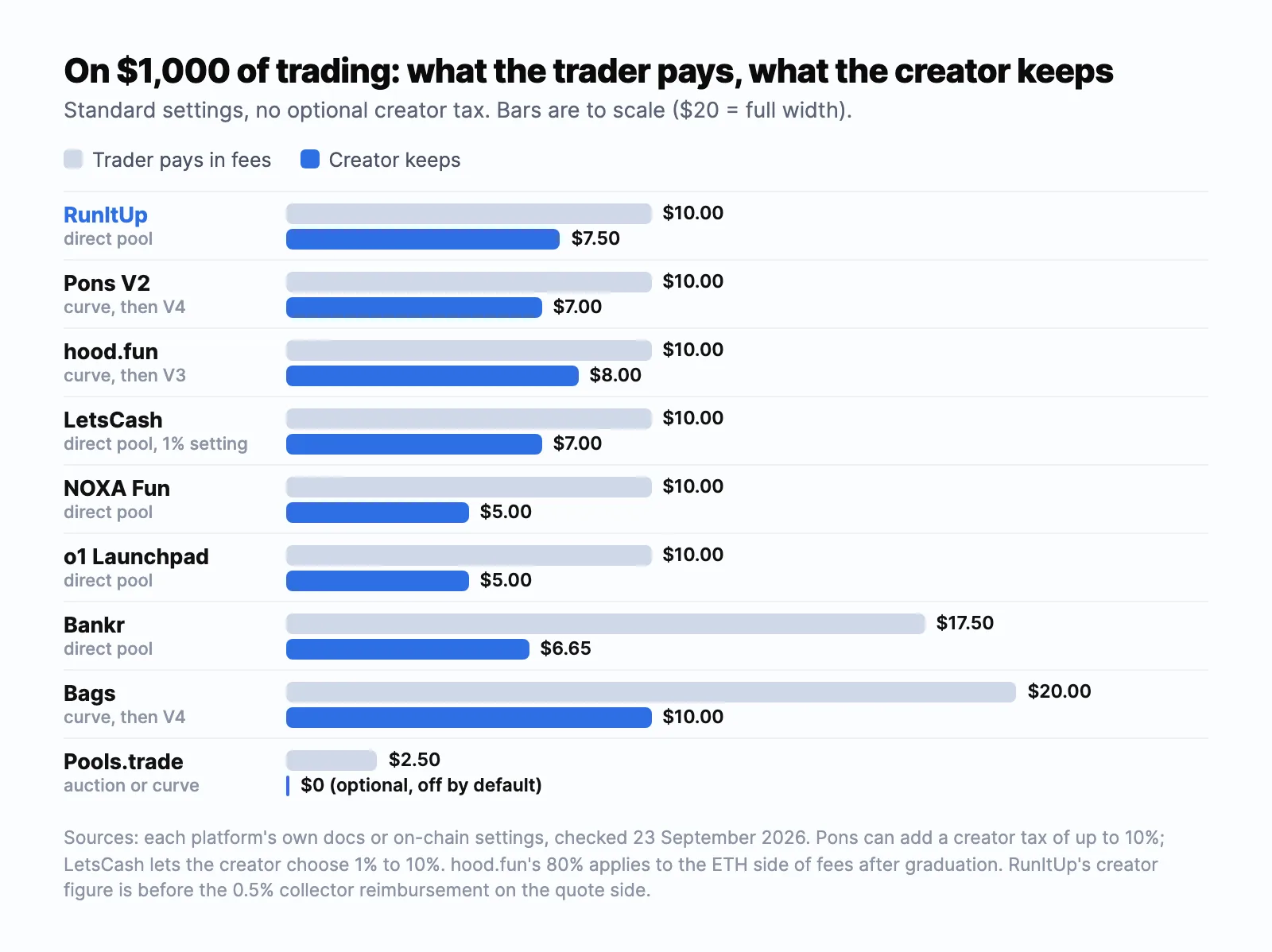
Two things jump out. Bags pays creators the most per trade, but only because it charges traders double. And the gap between a 50% share and a 75% share is the difference between $5 and $7.50 on every $1,000, which over a coin's life is most of what a creator earns.
Each Robinhood Chain launchpad, one by one
Pons: the biggest Robinhood Chain launchpad by a distance
Pons is where most launches on the chain happen. On DefiLlama, Pons V2 shows about $138 million of fees on Robinhood Chain over the last 30 days, far ahead of everyone else. That figure includes creator taxes, so it is not directly comparable with platforms whose only fee is 1%, but the lead is real either way.
How it works, from its own documentation: every launch starts on a bonding curve holding the whole supply. Once the curve sells out it graduates into a Uniswap V4 pool whose liquidity is locked permanently in its Launch Locker. On-chain, the launch fee reads 0.0005 ETH and graduation happens at 4.2 ETH.
Traders pay 1% on the curve and in the pool. On top of that, a creator can set a tax of up to 10%, fixed at launch, which goes entirely to them. Pons takes its share of the base fee first (30%, per its on-chain settings), and the creator gets the rest plus the whole tax.
Two points in Pons' favour that we want to state plainly. Its creators are paid only in the pairing asset: fees that land in the token are sold back into the pool before payout. And its sniper protection is aggressive: a tax that starts at 99% of a buy and decays to nothing over five seconds, with the launcher exempt.
The trade-offs: fees are not pushed to you. They build up in an escrow balance that you withdraw yourself. And as a trader, the creator tax varies from coin to coin, so you have to check each one before you buy.
hood.fun: the highest creator share among the 1% platforms
hood.fun uses a bonding curve that sells 80% of the supply and graduates at about 6.5 ETH raised into a 1% Uniswap V3 pool, locked forever in a locker with no owner and no withdraw function. Creating a coin costs only gas.
Its creator share is 80%, frozen per coin at launch, which beats ours. After graduation that 80% applies to the ETH side of fees, and the token side is burned. Creators claim when they like, or can switch on "community mode" to pay holders instead.
The catch is on the way out of the curve: its whitepaper lists a migration fee of "0.05 ETH + 3% of raise + 0.5 ETH protocol", which takes a real bite of what a successful coin raised. Its homepage still describes parts of the product as a concept preview, and it is not listed on DefiLlama, so there is no independent volume figure.
LetsCash: the tax-first Robinhood Chain launchpad
LetsCash puts the full supply straight into a Uniswap V4 pool, locked by a hook that refuses every attempt to remove liquidity. The creator chooses the trading fee, 1%, 3%, 5% or 10%, and can never raise it. The platform keeps 0.3% and the creator keeps the rest, claimable in ETH or USDG, never in the memecoin.
That makes it the most generous platform here for a creator who picks a high rate, and the most expensive for the trader of that coin. At the 1% setting the creator keeps $7.00 of every $1,000, just under ours. It runs only on Robinhood Chain and shows about $45 million of 30-day volume on DefiLlama.
NOXA Fun and o1 Launchpad: half to the creator
Both put the whole supply into a real pool from block one and lock it for good. Both charge a 1% fee and give the creator half.
NOXA is free to launch, uses Uniswap V3, pays creators in ETH on claim, and lets only the creator buy in the launch block, then caps buy size for the first hour. Its DefiLlama fees peaked in July and have fallen a long way since.
o1 charges 0.001 ETH, uses Uniswap V4 and supports the widest range of pairs: ETH, USDG and 194 stock tokens. Its fee starts at 99% and falls to 1% over 20 seconds, but that launch surcharge goes to the platform, not the creator. Without a referrer, the platform keeps half of every fee.
Bankr and Bags: higher fees, different trade-offs
Bankr launches from a chat, a social post or its API, into a locked Uniswap V4 pool. Traders pay 1.75% all-in. The creator gets 0.665% of each trade, and the rest is split between liquidity, the protocol, a buyback of its own token and the Doppler contracts. It also reserves 15% of supply to vest to the creator over a year, which you can switch off.
Bags, which started on Solana, uses a bonding curve into Uniswap V4 with the LP locked. It charges 0.02 ETH to launch and a flat 2% on every trade, on the curve and after graduation. The creator gets half of that, 1% of volume, the highest per-trade payout here, paid for by the highest trading cost.
Pools.trade: Uniswap's own launchpad
Pools, built by Uniswap Labs, is the cheapest place to trade: no launch fee and a 0.25% pool fee. Its Crowd Launch is an auction where everyone pays the same clearing price, which is genuinely resistant to bundling.
The creator fee is optional, off by default, and cannot be switched on later. Its documentation and its app disagree on the rate (0.05% versus 0.1% of buys). With it off, fees deepen the locked liquidity instead. Its Instant Launch mode says in its own interface that it has no sniper protection.
RunItUp: direct pool, 75% forever, paid automatically
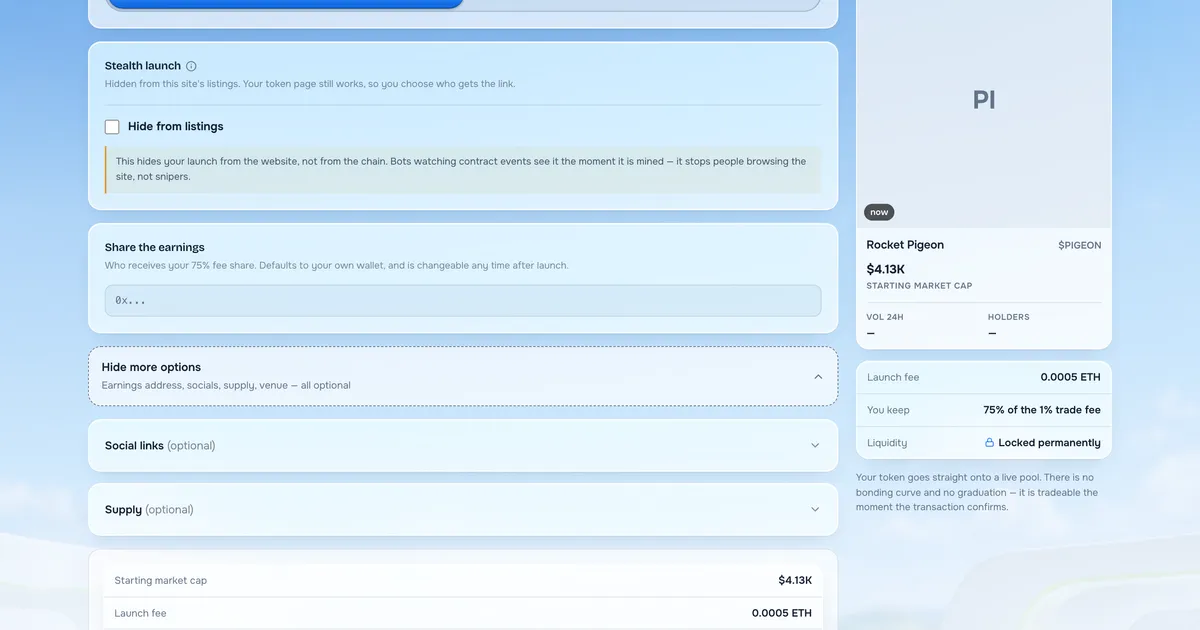
RunItUp puts your coin's full supply straight into a real pool at launch. You choose Uniswap V3, SushiSwap V3 or Uniswap V4, and you can pair it with ETH, the USDG stablecoin, or one of the chain's tokenised stocks. Launching costs 0.0005 ETH plus network gas, and every coin opens at the same starting market cap. Our step-by-step guide covers the form: how to launch a token on Robinhood Chain.
The fee is the pool's own 1% swap fee. The creator gets 75% of it for as long as the coin trades, and the platform gets 25%. There is no creator tax and no tax logic inside the token itself.
The liquidity position sits in a locker contract that has no withdraw function at all, not a restricted one and not a time-locked one. Nobody, including us, can pull it. The liquidity lock docs walk through how to check that yourself on the explorer.
The part we think matters most is how you get paid.
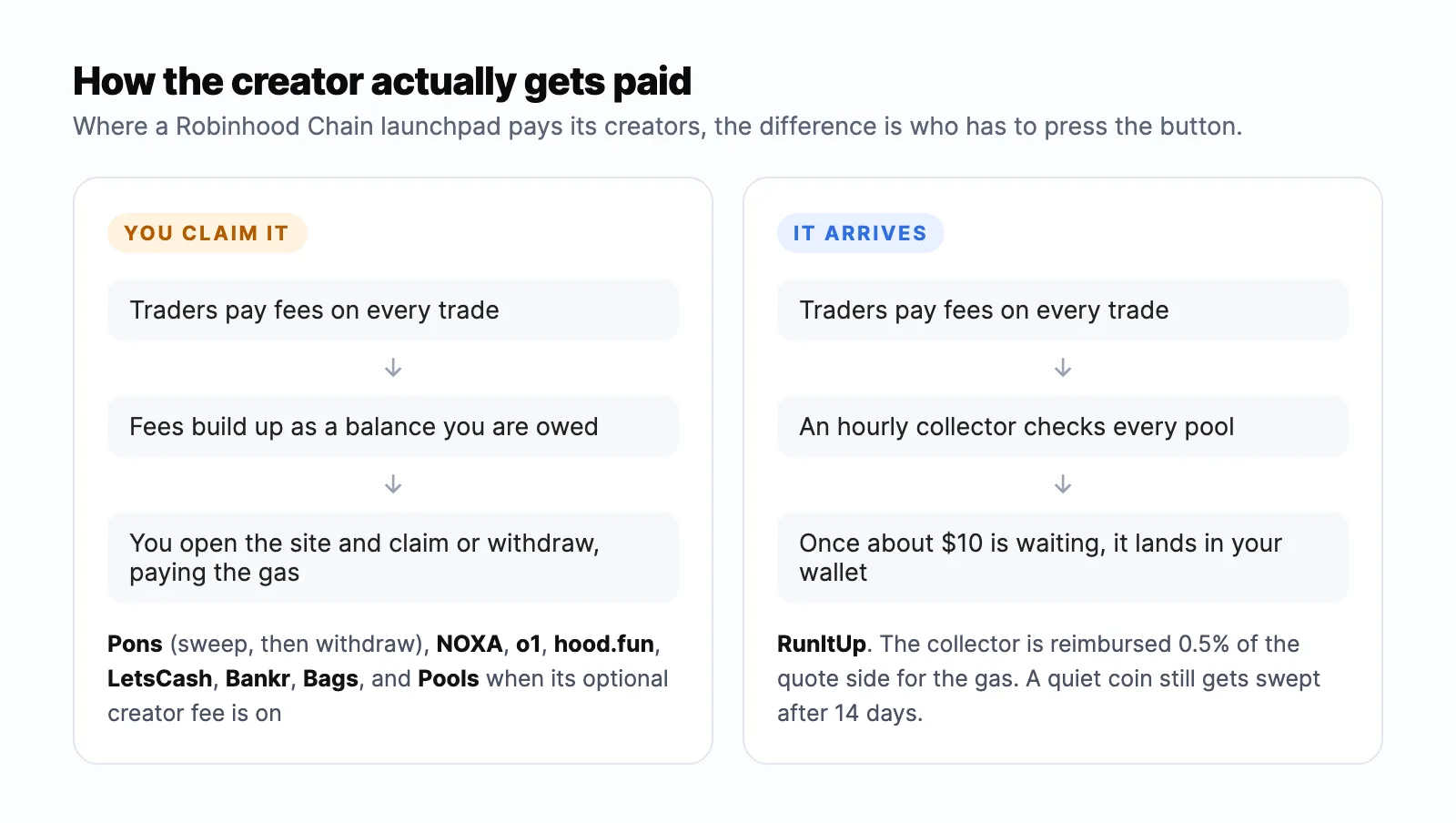
On every other platform here, fees build up as a balance and you come back to claim or withdraw them, paying the gas yourself. On RunItUp a collector checks every pool every hour and sends the money to your wallet once about $10 is waiting, or after 14 days for a quiet coin. That collector is reimbursed 0.5% of the quote side for the gas it spends, so on buys a creator receives 74.625% rather than a clean 75%. The details are in how the Keeper works.
Where we are honestly behind: hood.fun and LetsCash can pay a bigger share, and Bags a bigger amount per trade. Fees on a sell arrive partly in your own coin, where Pons converts them to the pairing asset first. We are not listed on DefiLlama yet, so there is no independent volume figure to point to. And our sniper tax is still paused pending audit, so today the only launch-time protection is that your dev buy runs inside the launch transaction, before anyone else can trade.
Sniper tax and anti-bot protection on each Robinhood Chain launchpad
Bots buy new coins in the first block and sell into the first real buyers. Platforms fight that in three ways.
A sniper tax charges a very high fee for the first few seconds and lowers it to normal. Pons starts at 99% and reaches zero over five seconds; o1 goes from 99% to 1% over 20 seconds; Bankr decays over about ten. The question to ask is who keeps the premium: on Pons it is distributed like normal fees, on o1 it goes to the platform.
Launch-block rules let only the creator buy in the first block. NOXA and Pons V1 do this, with per-wallet caps after.
Auctions remove the race entirely by giving everyone the same price, which is what Pools' Crowd Launch does.
RunItUp's sniper tax is built but paused until its audit is finished, so we do not count it here.
Which Robinhood Chain launchpad should you use
There is no single best answer, but there is usually a clear one for what you care about.
- You want the most people to see your coin: Pons. Most of the chain's launch activity happens there, and a curve with a snipe tax suits a hyped launch.
- You want the biggest share of a 1% fee: hood.fun at 80%, if you are comfortable with its curve and migration fee.
- You want to set a higher trading tax: LetsCash, or Pons with a creator tax. Remember that a high tax is also a reason for traders to skip your coin.
- You want traders to pay as little as possible: Pools, accepting that you probably earn nothing yourself.
- You want to pair with a stock token: o1 has the widest list; RunItUp and Pons also support them.
- You want a real pool from the first trade and your fees delivered without lifting a finger: that is the case we built RunItUp for. Launch a coin and see.
Whichever platform you pick, check the four things from the top of this guide on its own documentation before you sign: the model, the creator share and how it is paid, where the liquidity goes, and what traders pay. Every figure above can change, and a Robinhood Chain launchpad that was right last month may not be right today.
The rest of the field
Several smaller launchpads are live with lower volume. On DefiLlama's 30-day Robinhood Chain figures, Flap (curve into a Uniswap V2 fork, with optional tax tokens), PAIR (coins paired permanently with stock tokens), Virtuals (AI-agent tokens paid in VIRTUAL) and a long tail including Pez Family, StonkBrokers, Coinbarrel and Sentry each show between roughly $100,000 and $650,000 of fees. Clanker has deployed on the chain but shows very little activity there so far.
A few names that still turn up in listicles are not worth your time today: RobinPad's main site is offline and its sister site is a presale platform rather than a launchpad, and launch.win's own page says no tokens are indexed yet.
The chain is young and this list will move. We will update this Robinhood Chain launchpad comparison as platforms change their terms, including when ours do.